Explanation
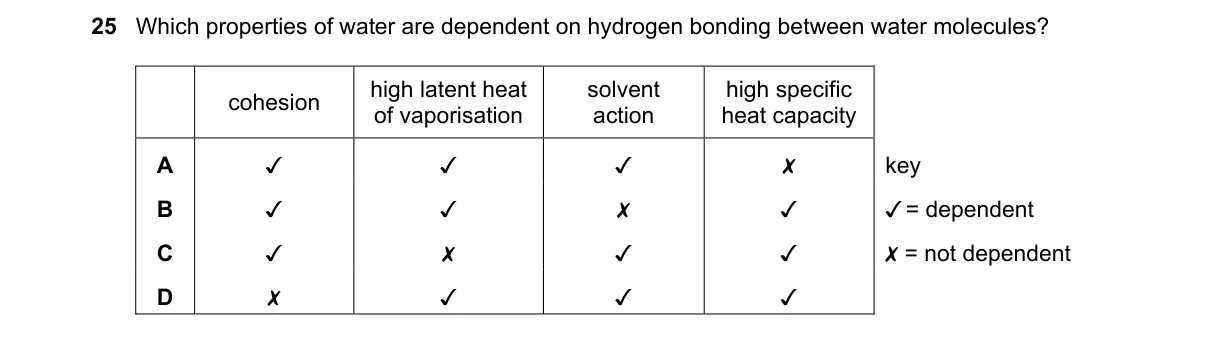
Hydrogen Bonding Enables Key Water Properties Steps: - Hydrogen bonding occurs between the partially positive H of one water molecule and partially negative O of another, creating strong intermolecular forces. - These bonds require significant energy to break, affecting thermal properties like specific heat capacity and latent heat of vaporization. - The bonding network enhances water's polarity, enabling solvent action for dissolving polar and ionic substances. - Evaluate options: A includes cohesion (due to H-bonds), but omits solvent action; B matches all three thermal and solubility effects; C swaps latent heat for cohesion; D lists only one. Why B is correct: - Hydrogen bonds between water molecules absorb heat without temperature rise (specific heat, ~4.18 J/g°C), require energy to overcome for evaporation (latent heat, 2260 J/g), and polarize water for H-bonding with solutes (solvent action per "like dissolves like" principle). Why the others are wrong: - A: Includes cohesion (surface tension from H-bonds) but excludes solvent action, a core H-bond-dependent property. - C: Includes cohesion but misses high latent heat of vaporization, essential for H-bond energy requirements. - D: Lists …
Practice more A Levels Biology (9700) questions on mMCQ.me