A Levels Biology (9700)•9700/13/M/J/24
Explanation
Water potential equilibrium in osmosis
Steps:
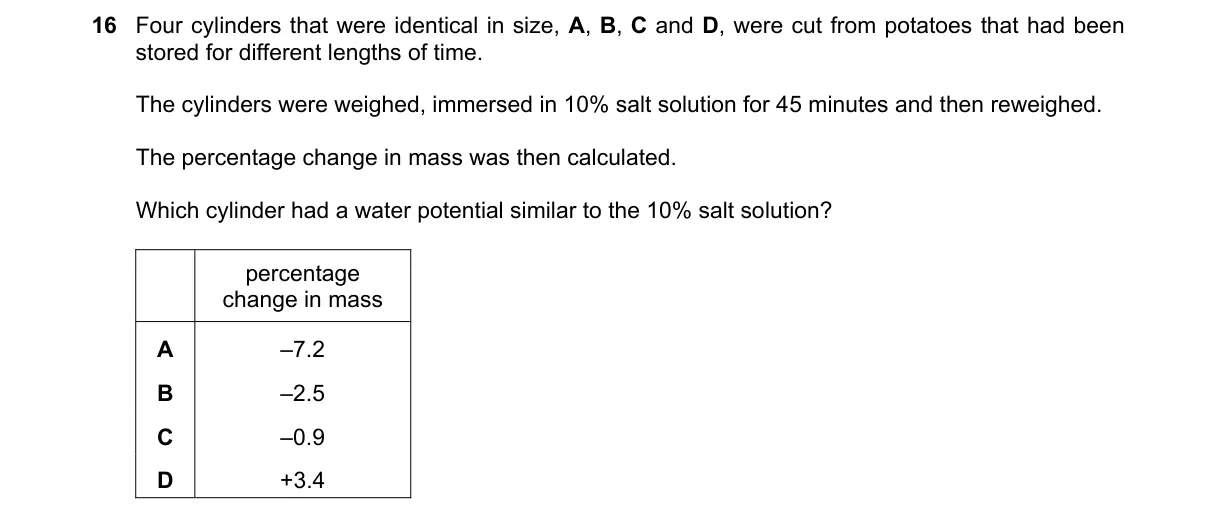
- In osmosis, water moves from higher to lower water potential; potato cylinders lose mass if their ψ > solution's ψ (negative % change) and gain if ψ < solution's ψ (positive % change).
- The 10% salt solution has low ψ due to solutes.
- Percentage change near zero indicates similar ψ, with no net water movement.
- Compare values: -7.2 (large loss), -3.9 (moderate loss), -0.9 (minimal loss), +3 (gain); -0.9 is closest to zero.
Why C is correct:
- Minimal mass change (-0.9%) means the cylinder's water potential equals the solution's, resulting in equilibrium with negligible net osmosis.
Why the others are wrong:
- A: Large mass loss (-7.2%) indicates much higher water potential, causing significant water efflux.
- B: Moderate mass loss (-3.9%) shows higher water potential than the solution, with net water loss.
- D: Mass gain (+3%) means lower water potential, driving water influx into the cylinder.
Final answer: C
Topic: Movement into and out of cells
Practice more A Levels Biology (9700) questions on mMCQ.me