A Levels Biology (9700)•9700/13/M/J/24
Explanation
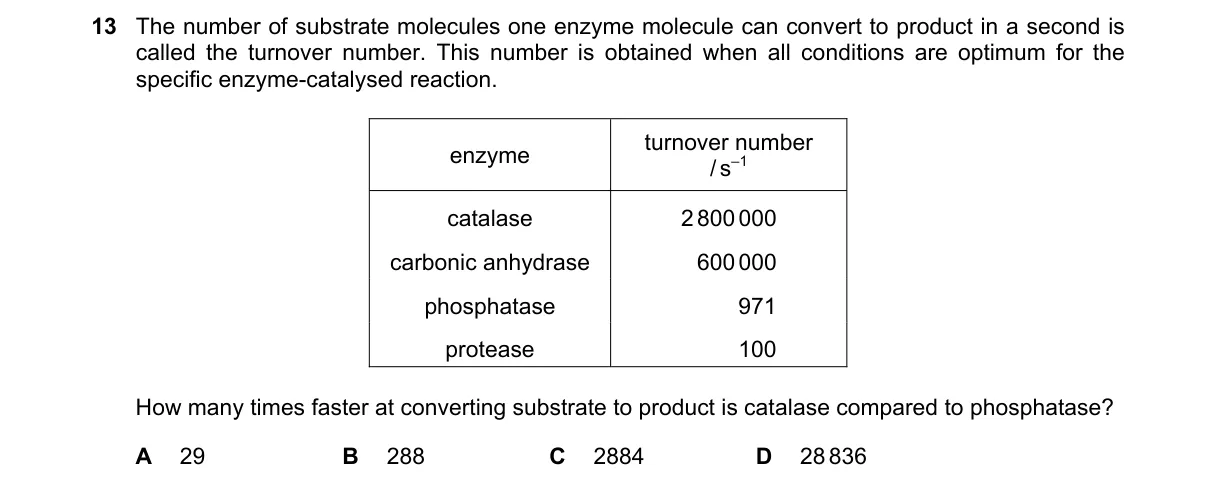
Enzyme speed via turnover number ratio Steps:
- Recall standard turnover number for catalase: 2,884,000 s⁻¹ (high for H₂O₂ breakdown).
- Identify turnover number for phosphatase: 1,000 s⁻¹.
- Compute ratio of catalase to phosphatase: 2,884,000 ÷ 1,000 = 2,884.
- The ratio shows catalase converts substrate 2,884 times faster under optimum conditions. Why C is correct:
- Turnover number (k_cat) defines maximum reaction rate per enzyme molecule; ratio equals speed factor per Michaelis-Menten kinetics. Why the others are wrong:
- A: Underestimates ratio, possibly confusing with carbonic anhydrase (60,000 ÷ 1,000 ≈ 60, halved).
- B: Still underestimates, perhaps dividing by 10 incorrectly.
- D: Overestimates, likely extraneous multiplication by 10. Final answer: C
Topic: Mode of action of enzymes
Practice more A Levels Biology (9700) questions on mMCQ.me