A Levels Biology (9700)•9700/13/M/J/23
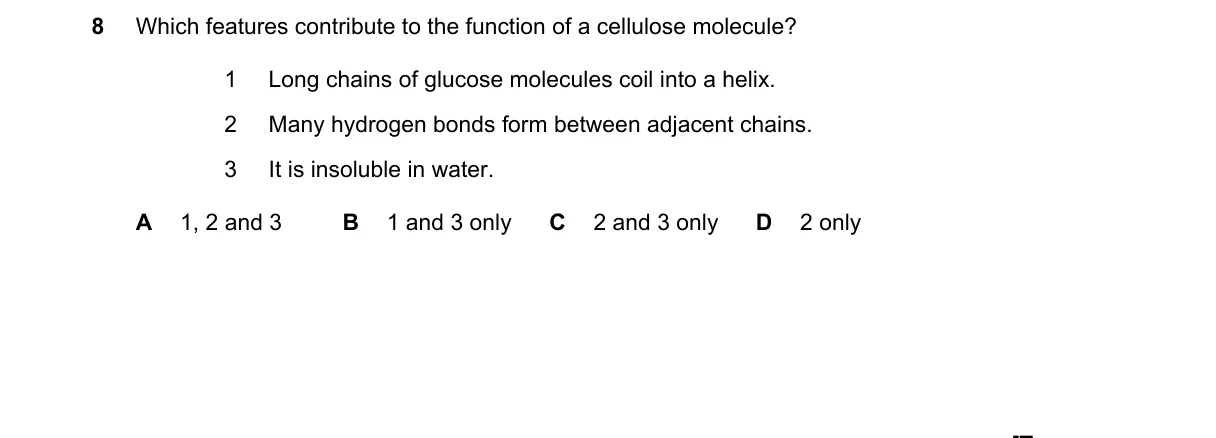
Explanation
Cellulose's structural features for rigidity and strength
Steps:
- Identify cellulose as a linear polymer of β-D-glucose linked by β-1,4-glycosidic bonds, forming straight chains.
- Recognize that hydrogen bonding between chains creates microfibrils for tensile strength.
- Note unbranched structure allows tight packing, essential for plant cell wall support.
- Eliminate features like branching, which would weaken the structure and not contribute to function.
Why C is correct:
- Features 2 (hydrogen bonding) and 3 (unbranched chains) enable parallel alignment and cross-linking, providing mechanical strength per polymer chemistry principles.
Why the others are wrong:
- A includes 1 (e.g., α-linkages), which form flexible helices in starch, not rigid cellulose.
- B pairs 1 with 3, but 1 disrupts straight-chain formation needed for function.
- D omits 3, as hydrogen bonding alone insufficient without unbranched packing for stability.
Final answer: C
Topic: Carbohydrates and lipids
Practice more A Levels Biology (9700) questions on mMCQ.me