A Levels Biology (9700)•9700/11/M/J/23
Explanation
Components Common to Blood and Tissue Fluid
Steps:
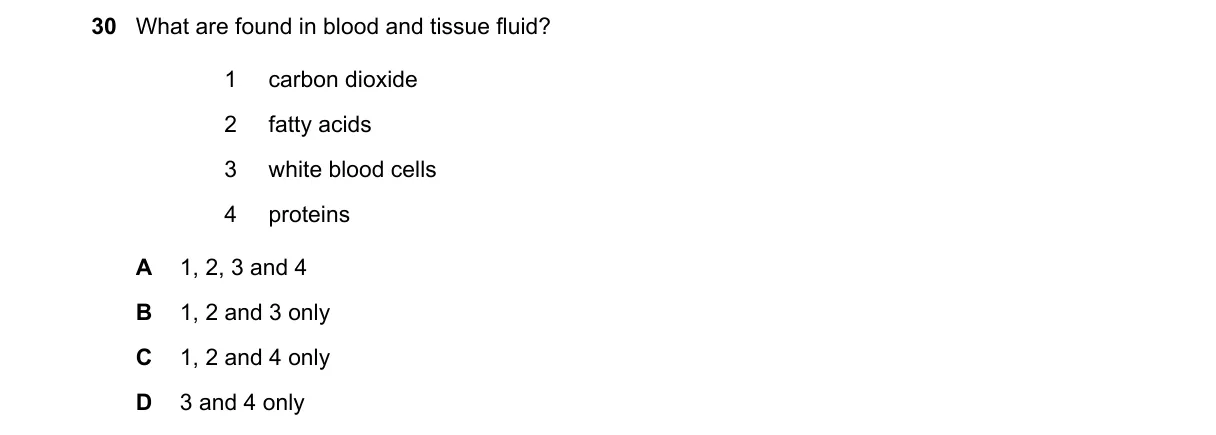
- Blood contains dissolved CO2, circulating fatty acids, white blood cells, and plasma proteins.
- Tissue fluid, an ultrafiltrate of blood plasma, includes dissolved gases like CO2, nutrients such as fatty acids, and small amounts of proteins, but excludes cellular elements.
- Compare presence: CO2 diffuses freely into tissue fluid; fatty acids transport via blood and enter interstitial spaces; proteins leak slightly from capillaries; white blood cells remain in vessels unless migrating.
- Identify matching option: 1 (CO2), 2 (fatty acids), and 4 (proteins) are in both.
Why A is correct:
- Tissue fluid derives from blood plasma, retaining soluble components like CO2, fatty acids, and proteins per Starling's forces on capillary exchange.
Why the others are wrong:
- B: Includes white blood cells, absent from tissue fluid as it's acellular.
- C: Omits fatty acids and proteins, both present in tissue fluid for nutrient and osmotic roles.
- D: Includes white blood cells and excludes CO2 and fatty acids, key dissolved solutes in both.
Final answer: A
Topic: The circulatory system
Practice more A Levels Biology (9700) questions on mMCQ.me