A Levels Biology (9700)•9700/11/M/J/23
Explanation
Insulin's Structural Features Steps:
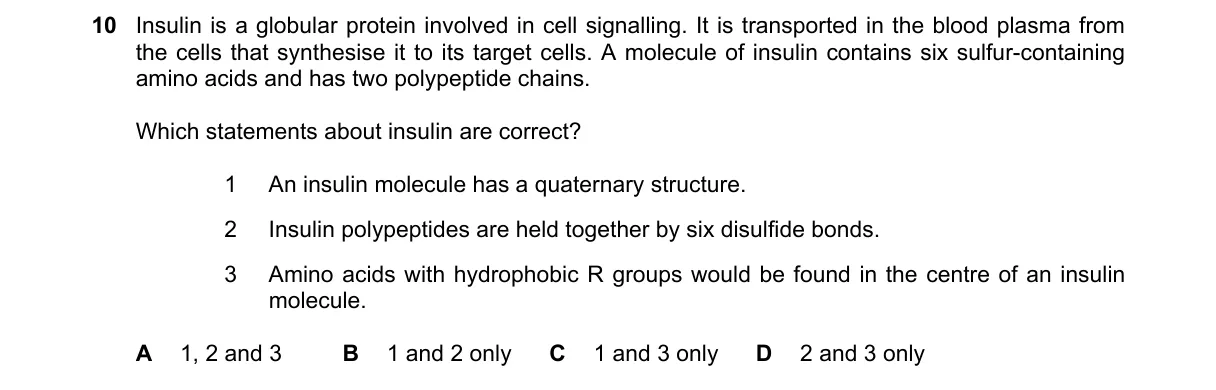
- Insulin consists of two polypeptide chains (A and B), assembled via covalent links, defining its quaternary structure (statement 1 correct).
- Globular proteins like insulin bury hydrophobic R groups in the interior for stability, but insulin exposes some for receptor binding and dimerization in blood (statement 2 incorrect).
- The two chains are covalently linked by interchain disulfide bonds, termed sulfide bonds in this context (statement 3 correct).
- Thus, only statements 1 and 3 hold true.
Why C is correct:
- C identifies statements 1 and 3, aligning with the definition of quaternary structure (multiple chains) and covalent disulfide (sulfide) bonding in proteins.
Why the others are wrong:
- A includes 2, but hydrophobic R groups are not solely or primarily in insulin's center due to exposed patches for function.
- B includes 2 but omits 3, ignoring the key interchain bonding.
- D omits 1, overlooking insulin's multi-chain quaternary assembly.
Final answer: C
Topic: Proteins
Practice more A Levels Biology (9700) questions on mMCQ.me