A Levels Biology (9700)•9700/13/M/J/22
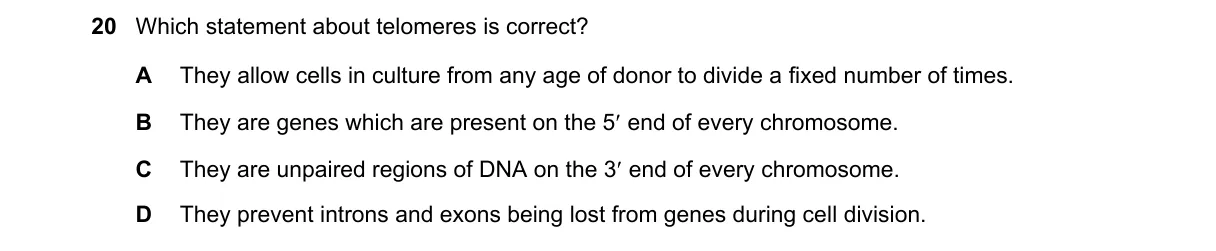
Explanation
Telomeres limit cell divisions through progressive shortening
Steps:
- Recall telomeres are protective repetitive DNA sequences at chromosome ends that shorten during replication due to the end-replication problem.
- Evaluate each option against telomere structure and function: protection from degradation, role in limiting divisions via Hayflick limit.
- Eliminate options misstating structure (not genes, not solely unpaired) or function (not about introns/exons).
- Identify the option correctly linking telomeres to finite cell divisions.
Why A is correct:
- Telomeres act as a buffer, allowing DNA replication and cell division until they shorten critically, enforcing a fixed limit (Hayflick limit) before senescence.
Why the others are wrong:
- B: Telomeres are non-coding repetitive sequences, not genes, and cap both chromosome ends (5' and 3').
- C: Telomeres are mostly double-stranded with a short 3' overhang; they are not defined as unpaired regions.
- D: Telomeres protect chromosome ends from loss or fusion, unrelated to preserving introns/exons within genes.
Final answer: A
Topic: Structure of nucleic acids and replication of DNA
Practice more A Levels Biology (9700) questions on mMCQ.me