A Levels Biology (9700)•9700/13/M/J/22
Explanation
Competitive Inhibition Reversibility
Steps:
- Recall that competitive inhibitors bind to the enzyme's active site, competing with the substrate.
- Understand that this binding is reversible and non-covalent, allowing substrate to displace the inhibitor.
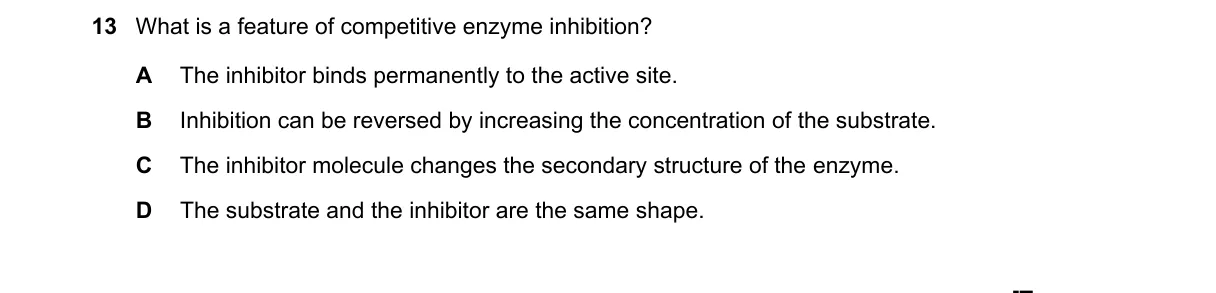
- Evaluate options: A suggests permanent binding (non-competitive trait), B matches reversibility by substrate increase, C involves structural changes (allosteric), D confuses shapes.
- Confirm B aligns with Michaelis-Menten kinetics, where Km increases but Vmax stays constant.
Why B is correct:
- In competitive inhibition, increasing substrate concentration overcomes inhibition by outcompeting the inhibitor for the active site, as defined in enzyme kinetics.
Why the others are wrong:
- A: Competitive inhibition is reversible, not permanent; permanent binding is irreversible inhibition.
- C: Competitive inhibitors do not alter secondary structure; they mimic substrate shape without changing enzyme conformation.
- D: Substrates fit the active site, but inhibitors compete by similar shape; enzymes do not share shape with both.
Final answer: B
Topic: Mode of action of enzymes
Practice more A Levels Biology (9700) questions on mMCQ.me