A Levels Biology (9700)•9700/12/M/J/22
Explanation
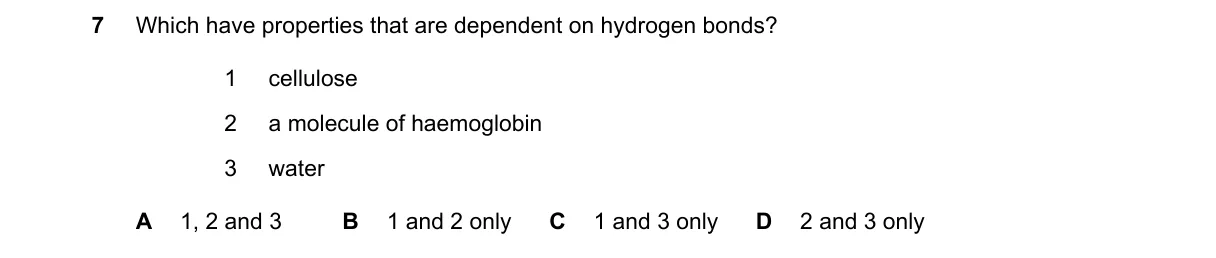
Hydrogen bonds determine key properties in cellulose, hemoglobin, and water
Steps:
- Hydrogen bonds form between electronegative atoms like oxygen and hydrogen in polar molecules.
- Cellulose, a polysaccharide, relies on hydrogen bonds between glucose chains for its rigid, fibrous structure.
- Hemoglobin, a protein, uses hydrogen bonds in its secondary and tertiary structures to maintain shape and oxygen-binding function.
- Water molecules form extensive hydrogen bonds, leading to properties like high boiling point and cohesion.
Why A is correct:
- All three substances exhibit properties directly resulting from hydrogen bonding, as defined by intermolecular forces between -OH groups or similar polar sites.
Why the others are wrong:
- B excludes water, ignoring its hydrogen bond-dependent anomalies like surface tension.
- C excludes hemoglobin, overlooking hydrogen bonds essential for protein folding.
- D excludes cellulose, disregarding hydrogen bonds that provide its tensile strength.
Final answer: A
Topic: Water
Practice more A Levels Biology (9700) questions on mMCQ.me