A Levels Biology (9700)•9700/12/M/J/22
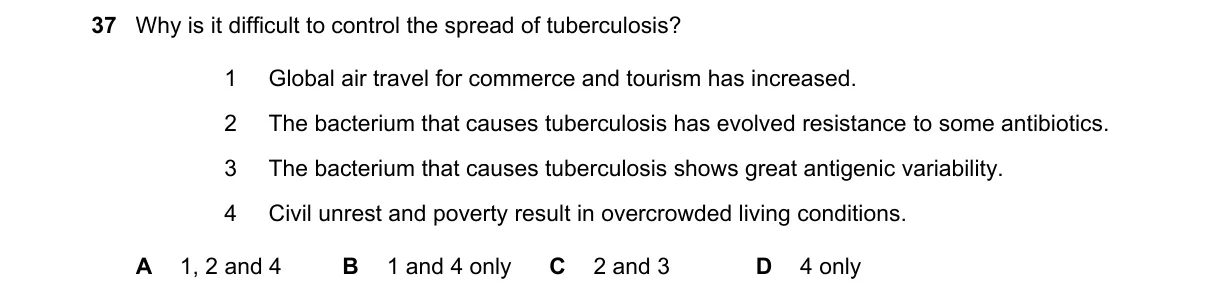
Explanation
Airborne transmission and latent infections hinder TB control
Steps:
- Identify key factors: Tuberculosis (TB) spreads via airborne droplets from coughing/sneezing infected individuals.
- Recognize challenges: Many infections are latent (asymptomatic), allowing silent spread without detection.
- Note resistance issues: Drug-resistant strains emerge from incomplete treatment, complicating eradication.
- Evaluate options: Correct choice combines factors 1 (airborne nature), 2 (latent phase), and 4 (drug resistance) as primary barriers.
Why A is correct:
- A encompasses the multifaceted reasons—airborne transmission (1), latency (2), and resistance (4)—aligning with WHO definitions of TB control difficulties.
Why the others are wrong:
- B omits latency and resistance, understating the issue.
- C excludes airborne spread, a core transmission mode.
- D ignores latency and transmission, focusing only on resistance.
Not enough information on exact statements for 1–4, but based on standard TB epidemiology.
Final answer: A
Topic: Infectious diseases
Practice more A Levels Biology (9700) questions on mMCQ.me