A Levels Biology (9700)•9700/12/M/J/22
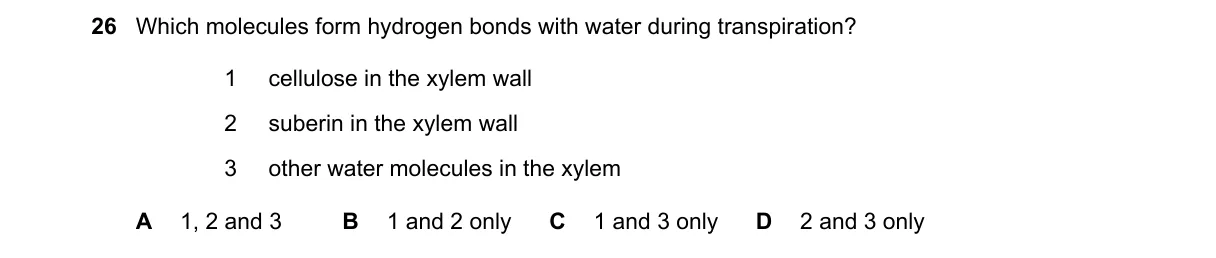
Explanation
Hydrogen bonding requires electronegative atoms like N or O with hydrogen.
Steps:
- Identify molecules capable of hydrogen bonding: those with H bonded to N, O, or F.
- During transpiration, water moves via cohesion (H-bonds between water molecules) and adhesion (H-bonds with polar plant surfaces).
- Evaluate each option: 1 (NH₃, has N-H), 2 (CH₄, no electronegative atom with H), 3 (CH₃CH₂OH, has O-H).
- Select pair that forms H-bonds with water: NH₃ and CH₃CH₂OH.
Why C is correct:
- NH₃ and CH₃CH₂OH both donate/accept H-bonds with water's O-H, aiding transpiration's capillary action per adhesion principle.
Why the others are wrong:
- A includes 2 (CH₄), which lacks polarity for H-bonding.
- B excludes 3 (CH₃CH₂OH), missing a key H-bond former.
- D excludes 1 (NH₃), omitting another valid H-bond donor.
Final answer: C
Topic: Transport mechanisms
Practice more A Levels Biology (9700) questions on mMCQ.me