A Levels Biology (9700)•9700/11/M/J/21
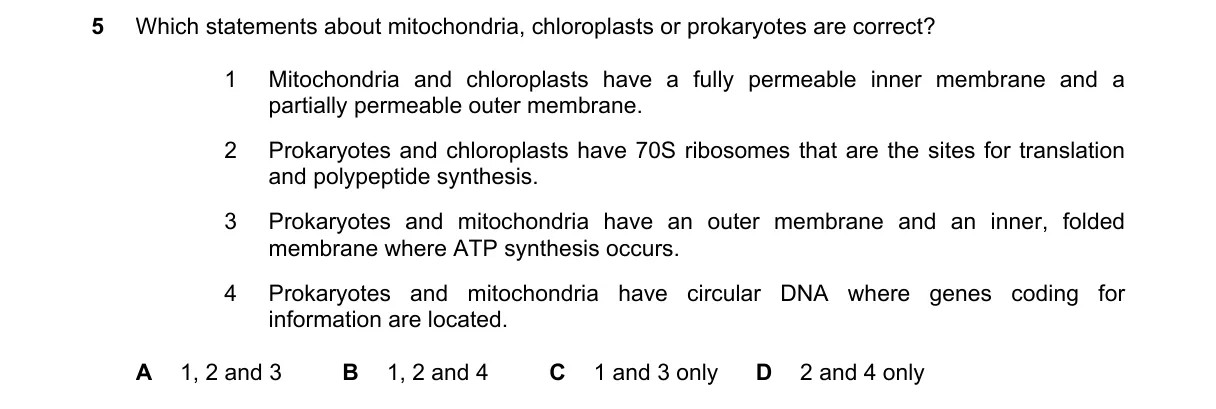
Explanation
Structural and Functional Features of Organelles and Prokaryotes
Steps:
- Statement 1 incorrect: Outer membranes of mitochondria and chloroplasts are porous via porins but not fully permeable to all molecules; inner membranes are selectively permeable.
- Statement 2 correct: Prokaryotes and chloroplasts both contain 70S ribosomes as sites of translation.
- Statement 3 incorrect: Prokaryotes synthesize ATP in their single plasma membrane; mitochondria do so only in the folded inner membrane, not outer.
- Statement 4 correct: Prokaryotes and mitochondria both have circular DNA encoding genes for rRNAs, tRNAs, and proteins.
Why D is correct:
- D identifies statements 2 and 4, matching prokaryotic-like features in chloroplasts (ribosomes) and mitochondria (DNA) per endosymbiotic theory.
Why the others are wrong:
- A includes incorrect statements 1 and 3 on membrane permeability and ATP sites.
- B includes incorrect statement 1 on membrane permeability.
- C includes incorrect statement 3 on ATP synthesis locations.
Final answer: D
Topic: Cells as the basic units of living organisms
Practice more A Levels Biology (9700) questions on mMCQ.me