A Levels Biology (9700)•9700/13/M/J/20
Explanation
Pathogen Stability and Vaccine Durability in Eradication
Steps:
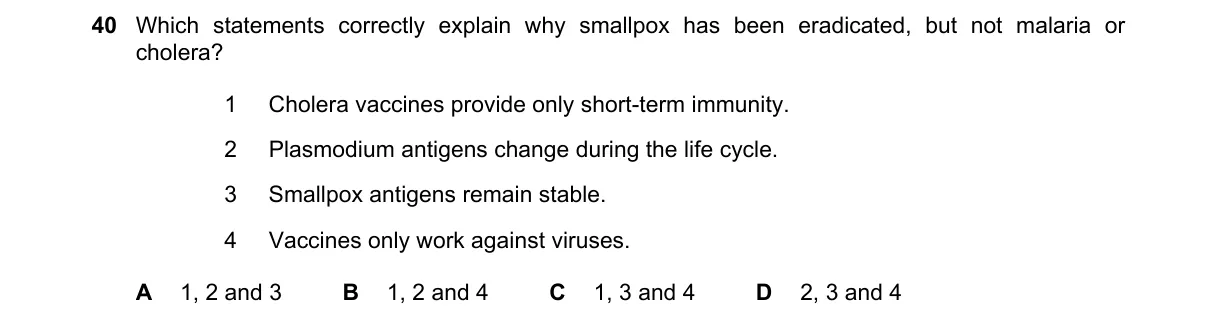
- Assess statement 1: Cholera vaccines confer short-term immunity, allowing reinfection and preventing eradication.
- Assess statement 2: Plasmodium's antigenic variation during its life cycle evades host immunity, complicating malaria control.
- Assess statement 3: Stable smallpox antigens enable consistent vaccine targeting for global elimination.
- Assess statement 4: Smallpox vaccines provide long-lasting but not universally lifelong immunity, so it doesn't fully explain eradication exclusivity.
Why A is correct:
- A selects statements 1, 2, and 3, which align with WHO criteria for eradication—requiring stable antigens and durable vaccines—highlighting smallpox's advantages over cholera's fleeting protection and malaria's variability.
Why the others are wrong:
- B omits malaria's antigenic challenge (2) and smallpox stability (3), ignoring key barriers.
- C includes overstated lifelong immunity (4) while missing malaria's variation (2).
- D excludes cholera's short-term vaccine issue (1) and smallpox stability (3), focusing too narrowly.
Final answer: A
Topic: Antibodies and vaccination
Practice more A Levels Biology (9700) questions on mMCQ.me