A Levels Biology (9700)•9700/13/M/J/20
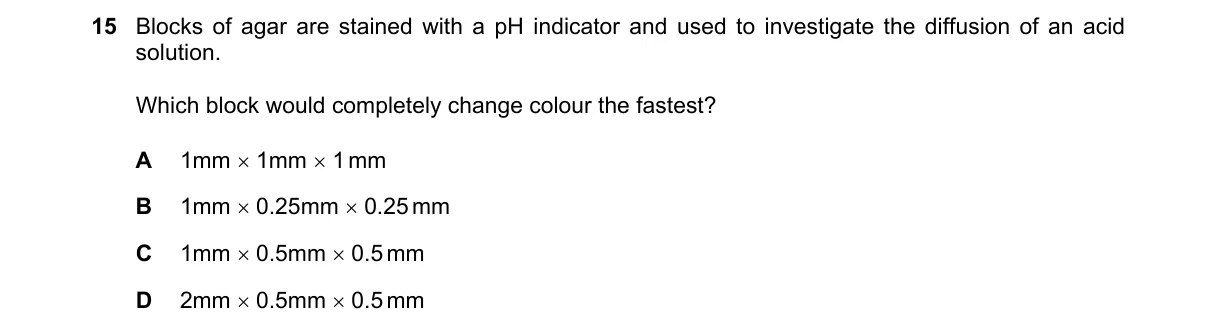
Explanation
Diffusion rate depends on thinnest dimension and exposed surface area Steps:
- Identify thinnest dimension for each block, as acid diffuses shortest path to center there.
- Compute half thinnest dimension: time ∝ (distance)^2 from diffusion equation.
- For flat shapes, large exposed faces accelerate influx via higher surface area.
- Compare: smallest effective distance with maximal area yields fastest complete change.
Why B is correct:
- Thinnest dimension 1 mm (distance 0.5 mm) with flat shape and large 2.5 mm × 2.5 mm faces maximize acid influx per Fick's first law (flux = -D × area × ∇c).
Why the others are wrong:
- A: Same 1 mm thickness but cubic shape limits exposed area, reducing influx rate.
- C: Thinnest 2 mm (distance 1 mm) doubles squared time, slowing diffusion.
- D: Thin 0.5 mm dimensions but elongated 2 mm length delays acid reaching far interior along axis.
Final answer: B
Topic: Movement into and out of cells
Practice more A Levels Biology (9700) questions on mMCQ.me