A Levels Biology (9700)•9700/12/M/J/20
Explanation
Properties of Single-Stranded DNA in Viruses
Steps:
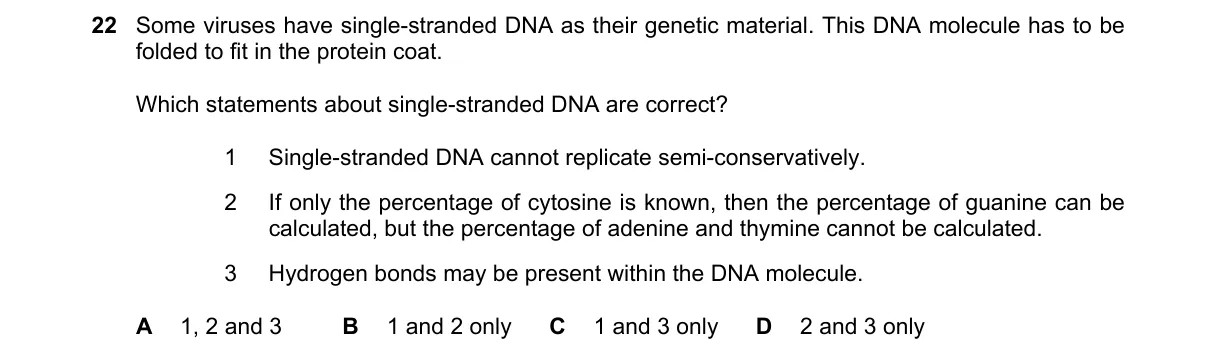
- Statement 1 is correct: ssDNA lacks a complementary strand, so it cannot undergo semi-conservative replication like dsDNA, where each strand templates the other.
- Statement 2 is incorrect: ssDNA has unpaired bases, so %C does not pair with %G (unlike Chargaff's rules for dsDNA), preventing calculation of %G, %A, or %T.
- Statement 3 is correct: ssDNA can form intramolecular folds like hairpins, stabilized by hydrogen bonds between bases.
- Valid statements are 1 and 3, corresponding to option C.
Why C is correct:
- C identifies 1 and 3 only, aligning with ssDNA's lack of complementary pairing (no semi-conservative replication) and ability to form internal H-bonds, per molecular biology principles.
Why the others are wrong:
- A includes 2, but ssDNA violates base-pairing rules, so %C alone yields no other base percentages.
- B includes 2 (false, as above) and omits 3's valid intramolecular bonding.
- D omits 1, ignoring ssDNA's inability to replicate semi-conservatively without first forming dsDNA.
Final answer: C
Topic: Structure of nucleic acids and replication of DNA
Practice more A Levels Biology (9700) questions on mMCQ.me