A Levels Biology (9700)•9700/11/M/J/20
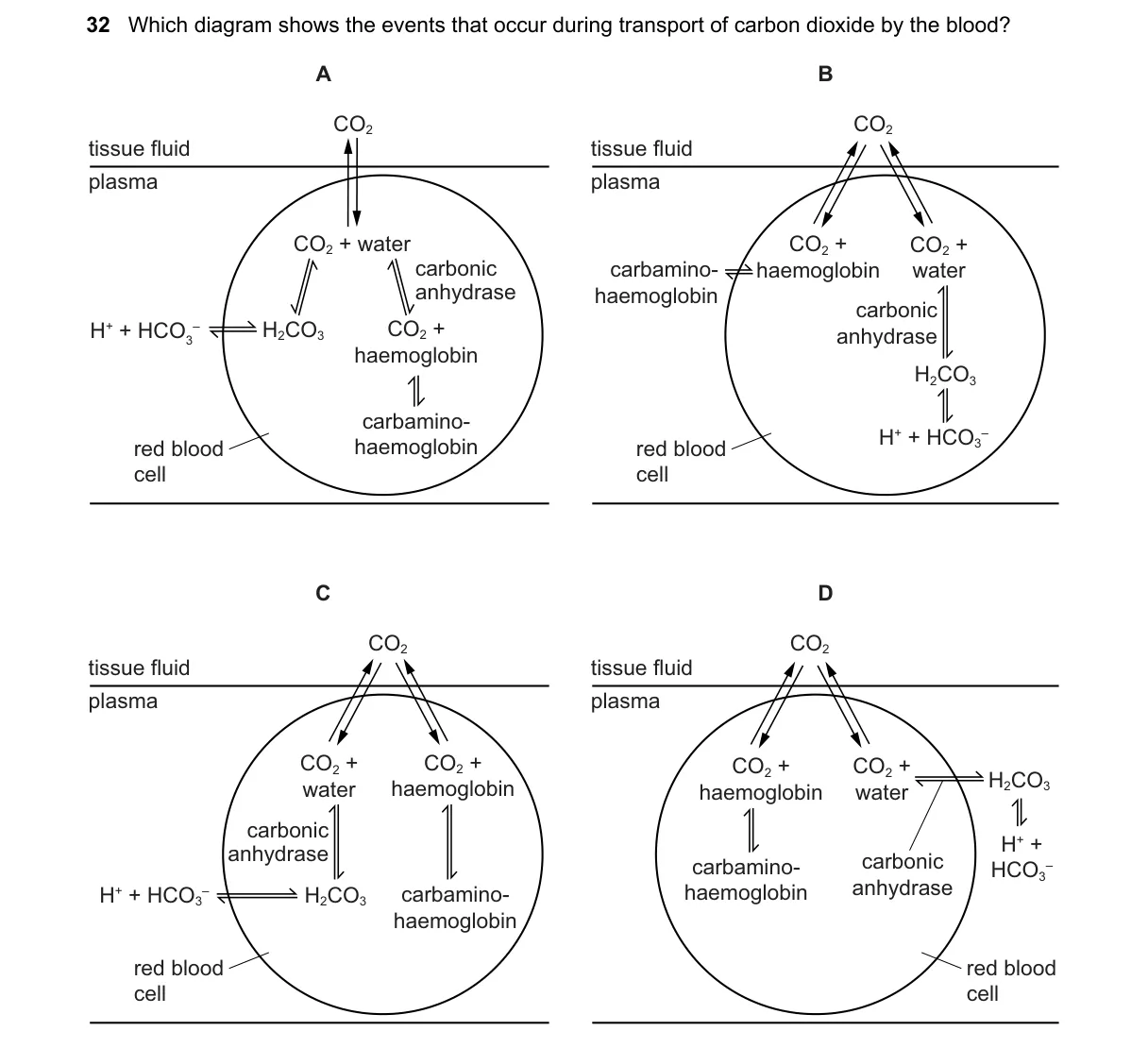
Explanation
Carbon Dioxide Transport Mechanisms
Steps:
- CO2 diffuses from tissues into blood plasma and red blood cells (RBCs).
- Inside RBCs, CO2 combines with water via carbonic anhydrase to form carbonic acid (H2CO3), which dissociates into bicarbonate (HCO3-) and H+ ions.
- HCO3- exits the RBC in exchange for chloride ions (Cl-) via the chloride shift, allowing transport in plasma.
- At the lungs, the process reverses: HCO3- re-enters RBCs, reforms CO2, which diffuses out for exhalation.
Why C is correct:
- Diagram C illustrates the bicarbonate pathway and chloride shift, accounting for ~70% of CO2 transport per physiological definitions.
Why the others are wrong:
- A: Depicts only dissolved CO2 (~7%), omitting dominant bicarbonate and carbaminohemoglobin forms.
- B: Shows CO2 binding solely to plasma proteins, ignoring RBC-specific reactions.
- D: Reverses the sequence, placing lung events before tissue uptake.
Final answer: C
Topic: Transport of oxygen and carbon dioxide
Practice more A Levels Biology (9700) questions on mMCQ.me