A Levels Biology (9700)•9700/11/M/J/20
Explanation
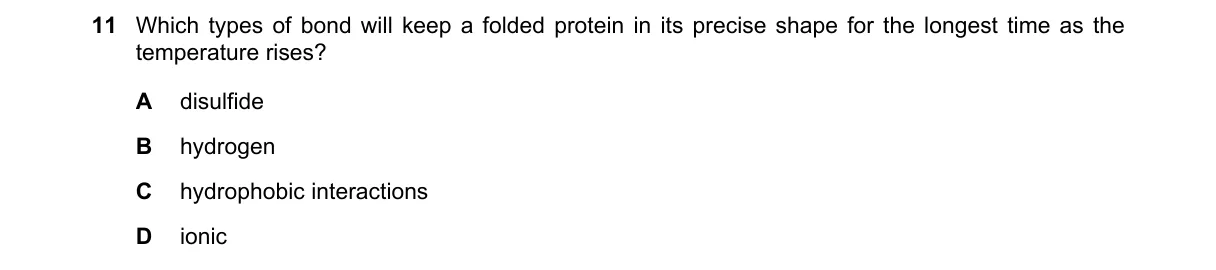
Disulfide bonds provide thermal stability in proteins
Steps:
- Identify bond types stabilizing protein structure: covalent (disulfide), non-covalent (hydrogen, hydrophobic, ionic).
- Evaluate temperature effects: heat increases kinetic energy, disrupting weaker non-covalent bonds first.
- Compare bond strengths: disulfide bonds are covalent and require high energy to break, unlike others.
- Determine longest stability: covalent disulfide bonds persist longest under rising temperature.
Why A is correct:
- Disulfide bonds are covalent linkages between cysteine residues, with bond energy (~250 kJ/mol) far exceeding thermal disruption at physiological temperatures.
Why the others are wrong:
- B: Hydrogen bonds (~20 kJ/mol) break easily as heat increases molecular motion, leading to denaturation.
- C: Hydrophobic interactions rely on entropy and weaken with temperature via increased water solubility of nonpolar groups.
- D: Ionic bonds (~20-40 kJ/mol) are disrupted by thermal agitation and solvation effects in aqueous environments.
Final answer: A
Topic: Proteins
Practice more A Levels Biology (9700) questions on mMCQ.me