A Levels Biology (9700)•9700/13/M/J/19
Explanation
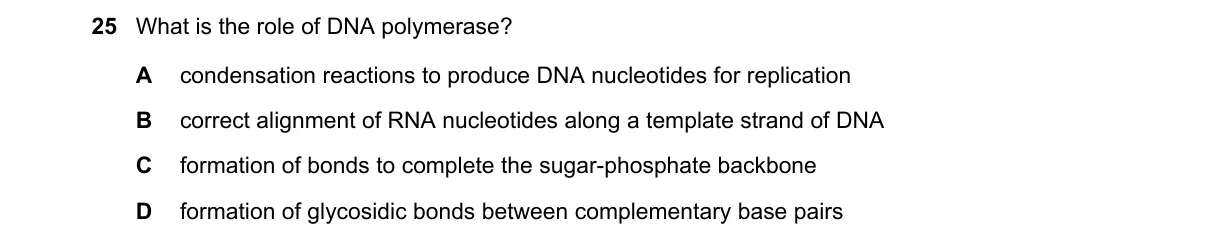
DNA Polymerase Catalyzes Phosphodiester Bond Formation
Steps:
- Recall DNA replication involves enzymes building new strands from a template.
- Identify DNA polymerase as the enzyme that adds nucleotides to the growing chain.
- Note it links nucleotides via phosphodiester bonds in the sugar-phosphate backbone.
- Eliminate options not matching this core function.
Why C is correct:
- DNA polymerase forms phosphodiester bonds between the 3' OH of the growing strand and the 5' phosphate of incoming nucleotides, completing the backbone per the mechanism of semi-conservative replication.
Why the others are wrong:
- A: Condensation reactions produce nucleotides beforehand; DNA polymerase uses pre-made ones.
- B: RNA nucleotides align via base pairing, but DNA polymerase works with deoxyribonucleotides on DNA templates.
- D: Glycosidic bonds form during nucleotide synthesis, not by DNA polymerase; it handles phosphodiester bonds, while base pairing is hydrogen bonding.
Final answer: C
Topic: Structure of nucleic acids and replication of DNA
Practice more A Levels Biology (9700) questions on mMCQ.me