A Levels Biology (9700)•9700/13/M/J/19
Explanation
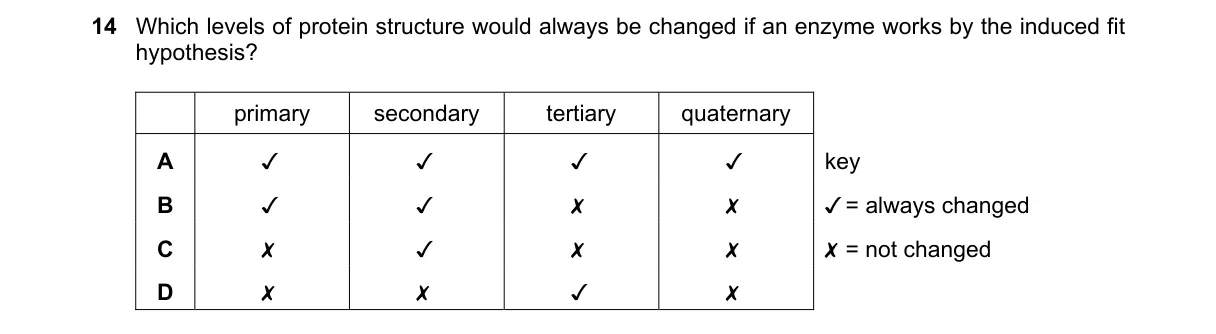
Induced Fit Alters Enzyme Conformation
Steps:
- Induced fit hypothesis states enzymes change shape to fit substrate precisely.
- This change involves folding adjustments in the enzyme's 3D structure.
- Primary structure (amino acid sequence) remains fixed and unchanged.
- Secondary structure (local folds like alpha helices) typically stays intact, while tertiary (overall 3D shape) and quaternary (subunit interactions) adjust for binding.
Why D is correct:
- Induced fit requires dynamic shifts in tertiary (single-chain folding) and quaternary (multi-subunit assembly) structures to form the active site, as defined by Koshland's model.
Why the others are wrong:
- A: Includes primary (sequence), which never changes in induced fit.
- B: Focuses on primary and secondary, but these are stable and unaffected.
- C: Omits quaternary, which changes in multi-subunit enzymes like hemoglobin.
Final answer: D
Topic: Mode of action of enzymes
Practice more A Levels Biology (9700) questions on mMCQ.me