A Levels Biology (9700)•9700/12/M/J/19
Explanation
Effects of Nicotine and Carbon Monoxide in Smoke
Steps:
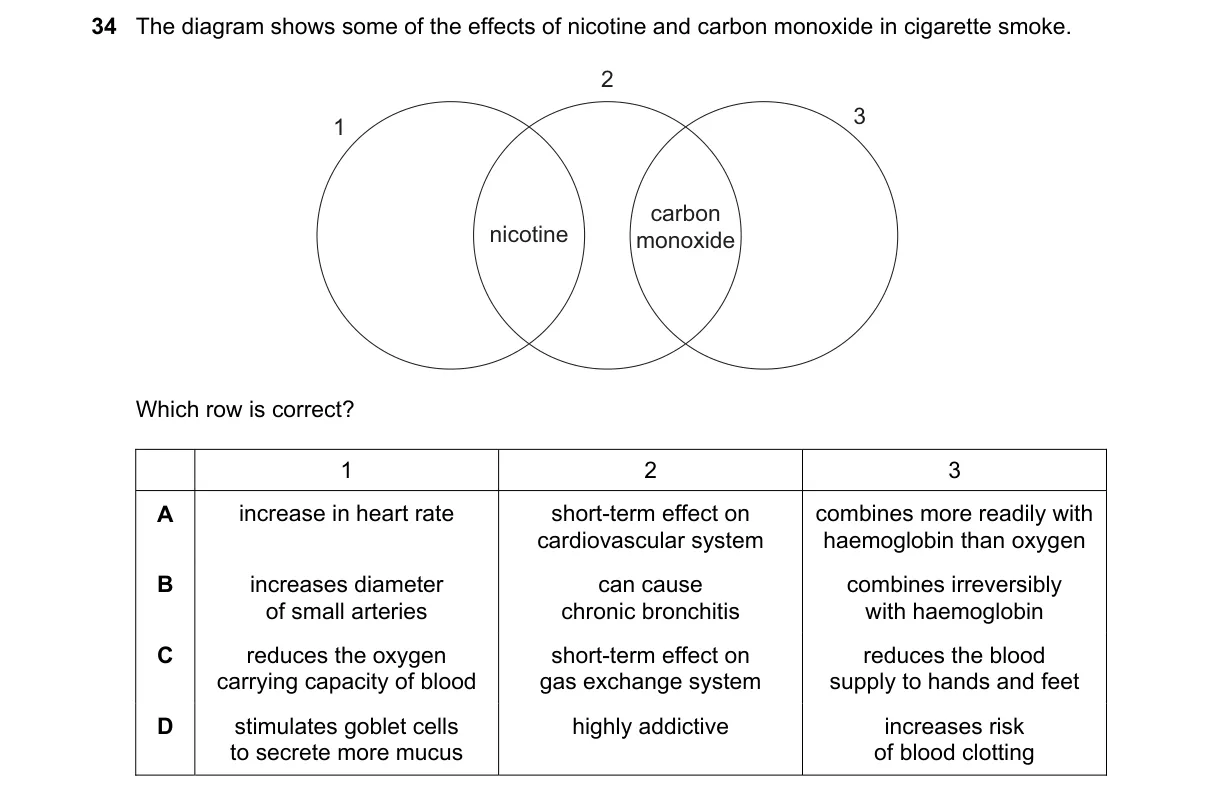
- Recall nicotine stimulates the cardiovascular system by increasing heart rate as a short-term effect.
- Recall carbon monoxide binds to hemoglobin more readily than oxygen, reducing oxygen transport.
- Match these to option A, which correctly describes both components.
- Eliminate other options for factual inaccuracies in effects or attributions.
Why A is correct:
- Nicotine acts as a stimulant on the sympathetic nervous system, elevating heart rate; carbon monoxide has 200–250 times greater affinity for hemoglobin than oxygen, per binding kinetics.
Why the others are wrong:
- B: Nicotine constricts small arteries; chronic bronchitis results from irritants like tar, not CO; CO binding is reversible.
- C: Reduced oxygen capacity affects blood transport, not short-term gas exchange; option is incomplete and misattributes.
- D: Goblet cell stimulation comes from smoke irritants, not nicotine/CO directly; clotting risk ties to other smoke components.
Final answer: A
Topic: Transport of oxygen and carbon dioxide
Practice more A Levels Biology (9700) questions on mMCQ.me