A Levels Biology (9700)•9700/12/M/J/19
Explanation
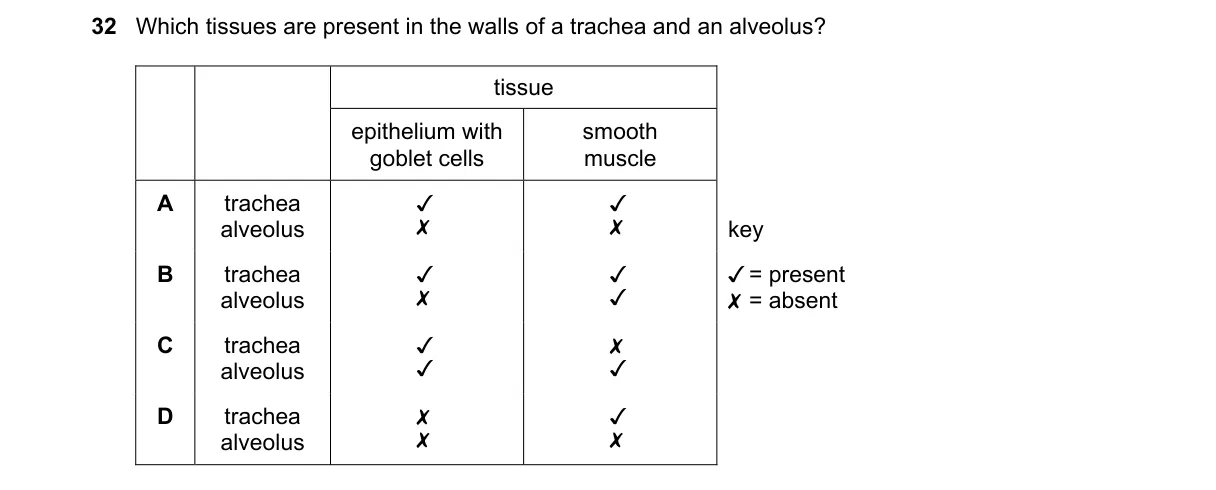
Respiratory tract tissue structures Steps:
- Identify trachea wall: contains hyaline cartilage rings, pseudostratified ciliated epithelium, smooth muscle.
- Identify alveolus wall: thin simple squamous epithelium, elastic fibers, no cartilage or glands.
- Compare for presence: trachea has supportive cartilage (present), alveolus lacks it (absent); both lack striated muscle.
- Match to options: A (x x) indicates tissues absent in both structures.
Why A is correct:
- Trachea and alveoli both lack voluntary striated muscle, per respiratory anatomy definitions emphasizing involuntary control.
Why the others are wrong:
- B (x ✓): Incorrectly suggests tissue absent in trachea but present in alveolus, ignoring trachea's unique cartilage.
- C (✓ x): Falsely places tissue in trachea but not alveolus, overlooking shared elastic components.
- D (x x): Duplicate of A, but question specifies single correct match.
Not enough information on exact tissue labels for x/✓. Final answer: A
Topic: The gas exchange system
Practice more A Levels Biology (9700) questions on mMCQ.me