A Levels Biology (9700)•9700/11/M/J/19
Explanation
High Altitude Training Adaptations
Steps:
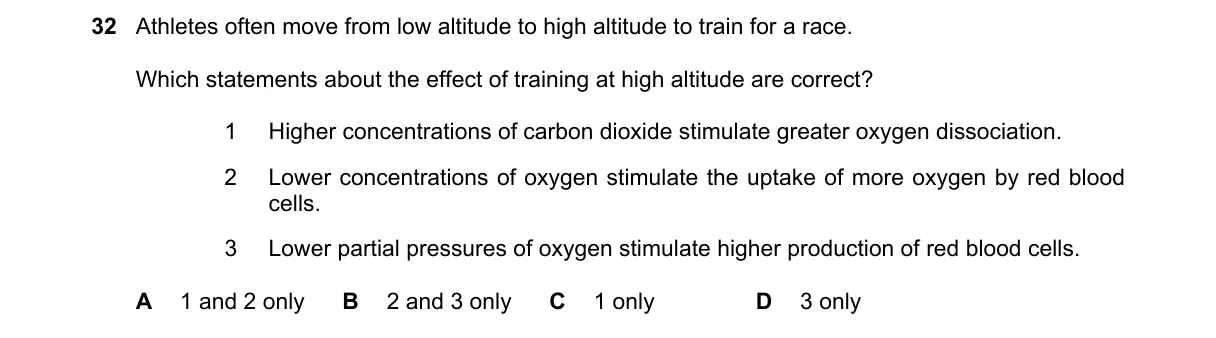
- Statement 1: At high altitude, hyperventilation reduces CO2 levels, so higher CO2 does not occur; Bohr effect requires elevated CO2 for greater oxygen unloading, making this false.
- Statement 2: Low oxygen partial pressure at high altitude impairs oxygen loading in lungs, reducing uptake by red blood cells initially, not increasing it.
- Statement 3: Athletes relocate from low to high altitude for training to trigger adaptations like erythropoietin release and increased red blood cell count, improving sea-level performance.
- Only statement 3 holds true, selecting option D.
Why D is correct:
- Statement 3 reflects the established "live high, train high" or acclimatization strategy, driven by hypoxia-induced physiological changes per altitude physiology principles.
Why the others are wrong:
- A incorrect: Includes false statements 1 and 2.
- B incorrect: Relies on false statement 2.
- C incorrect: Based on false statement 1.
Final answer: D
Topic: Transport of oxygen and carbon dioxide
Practice more A Levels Biology (9700) questions on mMCQ.me