A Levels Biology (9700)•9700/11/M/J/19
Explanation
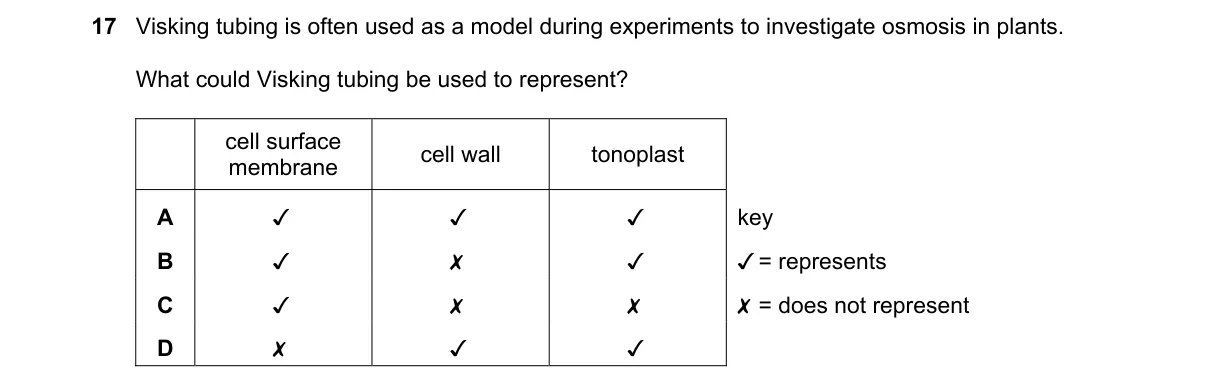
Visking tubing models semi-permeable barriers in osmosis
Steps:
- Identify Visking tubing as a selectively permeable membrane allowing water but not solutes like starch.
- Recall plant osmosis involves rigid cell wall, plasma membrane (cell surface), and tonoplast (vacuole membrane).
- Compare: Visking tubing mimics permeability of membranes but lacks structural features of plant components.
- Conclude it represents a general model, not specific plant structures listed.
Why B is correct:
- Visking tubing serves as an artificial analog for diffusion/osmosis processes, not tied to definitions of plant-specific organelles like membranes or walls.
Why the others are wrong:
- A: Visking tubing cannot model both membranes simultaneously or the impermeable cell wall.
- C: Tonoplast is the vacuolar membrane in plants; Visking tubing is a generic lab tool, not specific to vacuoles.
- D: Cell wall is rigid and non-permeable to water; Visking tubing is flexible and permeable.
Final answer: B
Topic: Movement into and out of cells
Practice more A Levels Biology (9700) questions on mMCQ.me