A Levels Biology (9700)•9700/13/M/J/18
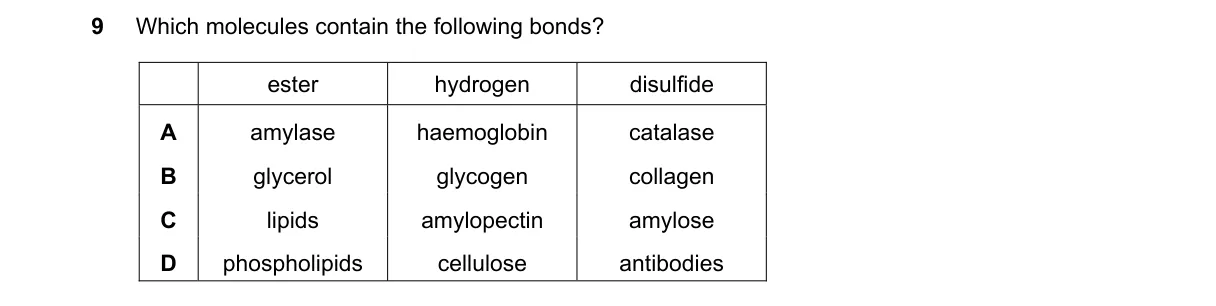
Explanation
Molecules with ester, hydrogen, and disulphide bonds
Steps:
- Ester bonds link fatty acids to glycerol in phospholipids.
- Hydrogen bonds occur in polysaccharides like cellulose and proteins like antibodies.
- Disulphide bonds form between cysteine residues in proteins like antibodies.
- Option D includes phospholipids (ester), cellulose (hydrogen), and antibodies (disulphide and hydrogen).
Why D is correct:
- Phospholipids feature ester bonds in their glycerol-fatty acid structure; cellulose has hydrogen bonds between glucose chains; antibodies contain disulphide bridges stabilizing their structure.
Why the others are wrong:
- A: All proteins (amylase, haemoglobin, catalase) have hydrogen and disulphide bonds but lack ester bonds.
- B: Glycerol and glycogen have hydrogen bonds; collagen has hydrogen and disulphide, but none have ester bonds.
- C: Lipids have ester bonds; amylopectin has hydrogen bonds; antibodies have disulphide, but cellulose is absent, and lipids are too general without specifying phospholipids.
Final answer: D
Topic: Carbohydrates and lipids
Practice more A Levels Biology (9700) questions on mMCQ.me