A Levels Biology (9700)•9700/13/M/J/18
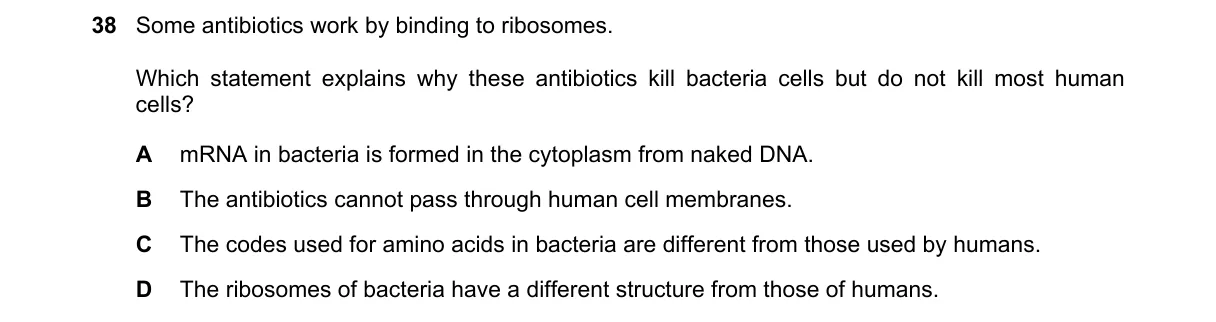
Explanation
Ribosomal Structural Differences Enable Selective Antibiotic Action
Steps:
- Identify the mechanism: Antibiotics target ribosomes for protein synthesis inhibition in bacteria.
- Compare cellular components: Bacterial ribosomes (70S) differ structurally from human eukaryotic ribosomes (80S).
- Evaluate selectivity: Structural variance allows antibiotics to bind bacterial ribosomes without affecting human ones.
- Eliminate irrelevant factors: Rule out options unrelated to ribosomal binding.
Why D is correct:
- Bacterial ribosomes are 70S (30S + 50S subunits) while human ribosomes are 80S (40S + 60S), creating binding site differences that prevent antibiotic attachment in humans, per ribosomal subunit assembly laws.
Why the others are wrong:
- A: Bacterial mRNA formation from naked DNA explains transcription location but not ribosomal binding specificity.
- B: Many antibiotics enter human cells via diffusion or transporters, yet spare human ribosomes due to structure.
- C: The genetic code is nearly universal across bacteria and humans, so codon-amino acid mappings are identical.
Final answer: D
Topic: Antibiotics
Practice more A Levels Biology (9700) questions on mMCQ.me