A Levels Biology (9700)•9700/13/M/J/18
Explanation
ATP Production in Eukaryotic Cells
Steps:
- ATP is the cell's energy currency, produced via specific organelle processes.
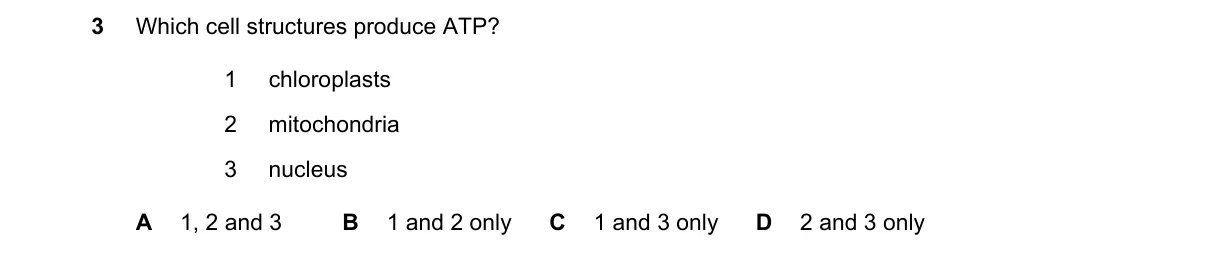
- Chloroplasts (in plant cells) generate ATP during photosynthesis through photophosphorylation.
- Mitochondria produce ATP in all eukaryotic cells via cellular respiration and oxidative phosphorylation.
- The nucleus stores genetic material but lacks ATP-producing machinery.
Why B is correct:
- Chloroplasts and mitochondria are the primary sites for ATP synthesis, as defined by their roles in light-dependent reactions and the electron transport chain.
Why the others are wrong:
- A includes the nucleus, which transcribes DNA but does not synthesize ATP.
- C omits mitochondria, the main ATP producer in respiration.
- D omits chloroplasts, which produce ATP in photosynthetic organisms.
Final answer: B
Topic: Energy
Practice more A Levels Biology (9700) questions on mMCQ.me