A Levels Biology (9700)•9700/13/M/J/18
Explanation
Hydrogen bonding drives water's thermal properties
Steps:
- Identify key properties: specific heat, latent heat, and solubility in water.
- Recall hydrogen bonds form between water molecules, requiring energy to break.
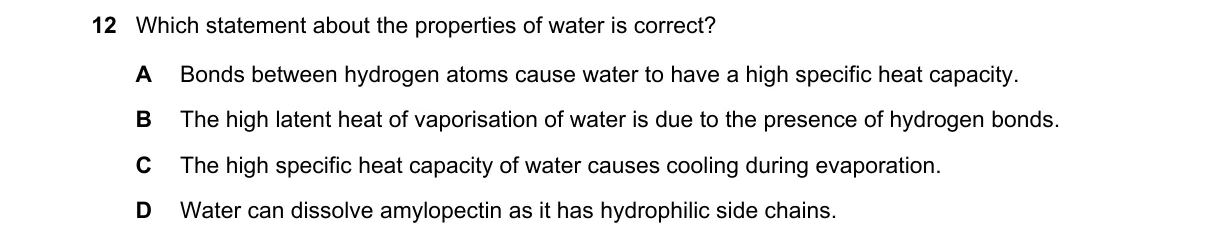
- Evaluate options: A misattributes bonds; B links to latent heat; C confuses heat capacities; D ignores amylopectin's insolubility.
- Confirm B matches definition of latent heat as energy to overcome intermolecular forces.
Why B is correct:
- Latent heat of vaporization is the energy needed to change liquid to gas, directly due to breaking strong hydrogen bonds between water molecules.
Why the others are wrong:
- A: High specific heat results from hydrogen bonds absorbing heat via molecular vibration, not bonds between hydrogen atoms (covalent bonds in H2O are intramolecular).
- C: Cooling during evaporation is caused by high latent heat absorbing heat, not specific heat capacity.
- D: Amylopectin, a branched starch, is insoluble in water due to hydrophobic regions despite some hydrophilic chains.
Final answer: B
Topic: Water
Practice more A Levels Biology (9700) questions on mMCQ.me