A Levels Biology (9700)•9700/12/M/J/18
Explanation
Haemoglobinic Acid in Blood Buffering
Steps:
- Haemoglobinic acid (HHb) forms when deoxyhemoglobin binds H⁺ ions released from carbonic acid.
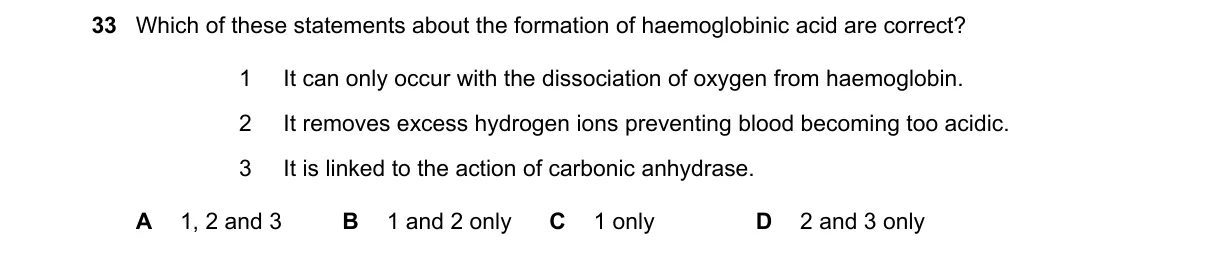
- Statement 1: Oxygen dissociation from HbO₂ produces deoxy-Hb, which readily accepts H⁺ to form HHb.
- Statement 2: HHb formation neutralizes excess H⁺ from CO₂ hydration, maintaining blood pH above 7.35.
- Statement 3: Carbonic anhydrase accelerates CO₂ + H₂O → H₂CO₃ → H⁺ + HCO₃⁻, supplying H⁺ for HHb.
Why A is correct:
- All statements align with the chloride shift and Haldane effect, where HHb buffers H⁺ during CO₂ transport (Hb + H⁺ ⇌ HHb).
Why the others are wrong:
- B omits carbonic anhydrase's essential role in H⁺ production.
- C ignores buffering and enzyme linkage.
- D excludes oxygen dissociation's facilitation of H⁺ binding.
Final answer: A
Topic: Transport of oxygen and carbon dioxide
Practice more A Levels Biology (9700) questions on mMCQ.me