A Levels Biology (9700)•9700/12/M/J/18
Explanation
tRNA Function in Translation
Steps:
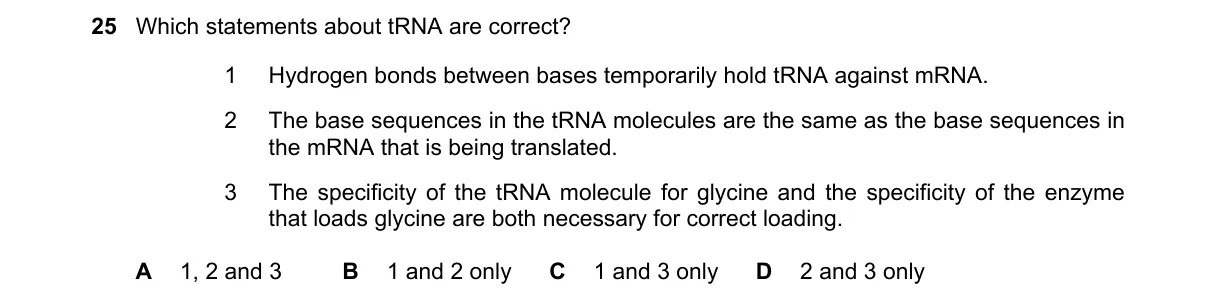
- Statement 1: tRNA anticodon forms hydrogen bonds with mRNA codon, temporarily holding tRNA to mRNA during translation.
- Statement 2: tRNA anticodon sequence is complementary (not identical) to mRNA codon sequence, enabling base pairing.
- Statement 3: Aminoacyl-tRNA synthetases are specific enzymes that attach the correct amino acid (e.g., glycine) to its matching tRNA.
- Correct statements are 1 and 3, corresponding to option C.
Why C is correct:
- C selects statements 1 and 3, which accurately describe tRNA-mRNA binding via hydrogen bonds and enzyme specificity in charging tRNA, per the central dogma of molecular biology.
Why the others are wrong:
- A includes 2, but tRNA sequences are complementary, not identical, to mRNA.
- B includes 2, which misstates sequence complementarity as identity.
- D excludes 1, but hydrogen bonding is essential for codon-anticodon recognition.
Final answer: C
Topic: Protein synthesis
Practice more A Levels Biology (9700) questions on mMCQ.me