A Levels Biology (9700)•9700/12/M/J/18
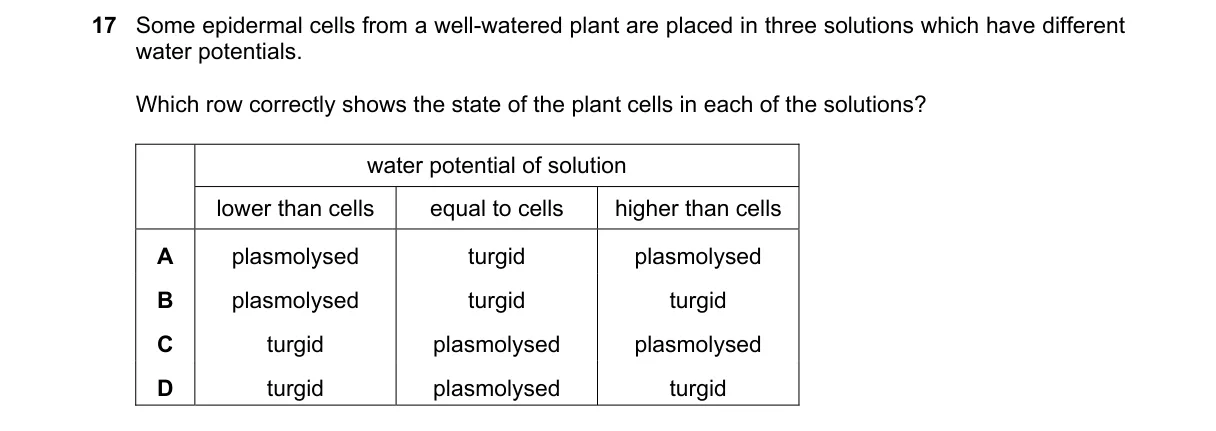
Explanation
Osmosis and Water Potential in Plant Cells
Steps:
- Well-watered plant cells start turgid with water potential Ψ_cell (typically negative, e.g., -0.5 MPa).
- Water moves from higher to lower water potential: if solution Ψ > Ψ_cell, water enters, causing turgidity.
- If solution Ψ < Ψ_cell, water exits, shrinking cytoplasm and causing plasmolysis.
- Solutions have different Ψ values; states depend on comparison to Ψ_cell (assume order: solution 1 Ψ > Ψ_cell, solution 2 Ψ < Ψ_cell, solution 3 Ψ > Ψ_cell).
Why B is correct:
- Matches osmosis principle: turgid in higher-Ψ solutions (water influx), plasmolysed in lower-Ψ solution (water efflux), per water potential gradient (Ψ_solution - Ψ_cell drives flow).
Why the others are wrong:
- A: Incorrectly shows plasmolysis in high-Ψ solutions where water should enter.
- C: Wrongly predicts plasmolysis in two solutions, ignoring turgidity in higher-Ψ ones.
- D: Duplicate of B, but listed separately; not distinct.
Final answer: B
Topic: Movement into and out of cells
Practice more A Levels Biology (9700) questions on mMCQ.me