A Levels Biology (9700)•9700/11/M/J/18
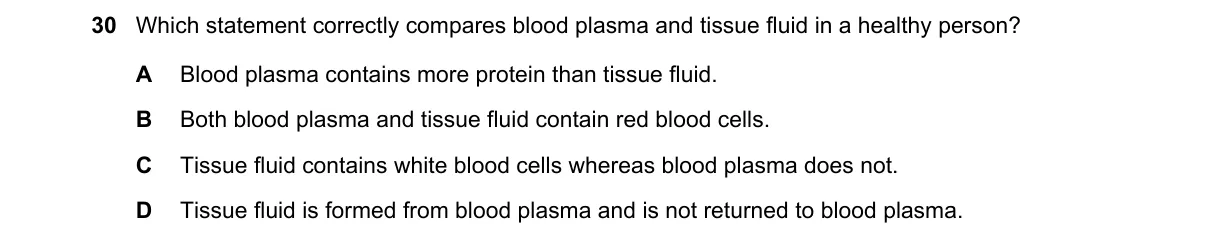
Explanation
Key differences in protein content between blood plasma and tissue fluid
Steps:
- Define blood plasma as the liquid component of blood, rich in proteins like albumin.
- Define tissue fluid as interstitial fluid formed by filtration from capillaries, excluding large proteins.
- Compare: Plasma retains proteins due to capillary permeability, while tissue fluid has lower protein levels.
- Evaluate options against these compositions to identify the accurate comparison.
Why A is correct:
- Capillary walls act as semi-permeable barriers; large protein molecules (e.g., globulins) are retained in plasma, resulting in higher protein concentration there than in tissue fluid.
Why the others are wrong:
- B: Blood plasma excludes all cells, including red blood cells, which are confined to whole blood.
- C: Blood plasma contains no white blood cells; both fluids lack them, as cells remain in blood vessels.
- D: Tissue fluid forms from plasma via ultrafiltration but returns to circulation via lymphatics, not directly to plasma.
Final answer: A
Topic: The circulatory system
Practice more A Levels Biology (9700) questions on mMCQ.me