O Level Accounting (7707)•7707/11/M/J/23
Explanation
Depreciation as a Non-Cash Accounting Allocation
Steps:
- Define depreciation: Systematic allocation of a non-current asset's cost over its useful life.
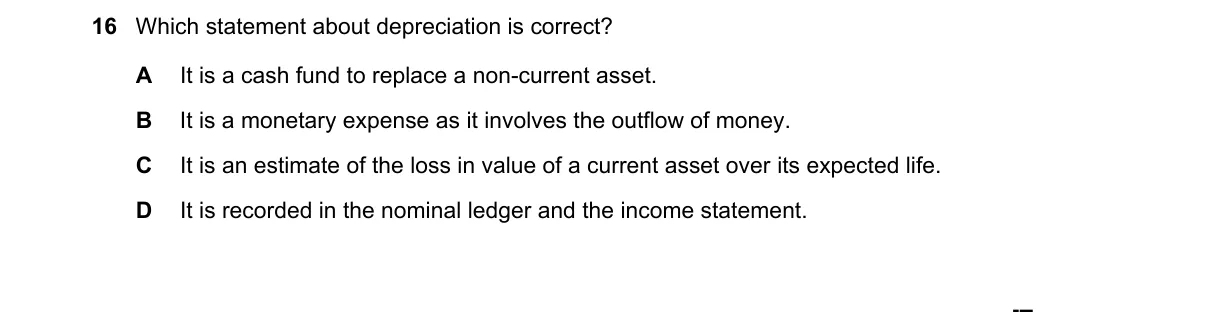
- Evaluate option A: Check if it creates a cash fund—depreciation is an accounting entry, not cash.
- Evaluate options B and C: Assess cash flow and asset type—depreciation involves no cash and applies to non-current assets.
- Evaluate option D: Confirm recording locations—depreciation appears in the nominal ledger for expenses and income statement for profit impact.
Why D is correct:
- Depreciation is an expense recorded in the nominal ledger (part of double-entry bookkeeping) and charged to the income statement to reduce profit, per accounting standards like IAS 16.
Why the others are wrong:
- A: Depreciation does not create a cash fund; it is a non-cash expense for asset cost allocation.
- B: It is a non-monetary expense with no cash outflow, only an accounting adjustment.
- C: Depreciation estimates loss in value for non-current (fixed) assets, not current assets like inventory.
Final answer: D
Topic: Accounting for depreciation and disposal of non-current assets
Practice more O Level Accounting (7707) questions on mMCQ.me