O Levels Biology (5090)•5090/12/O/N/23
Explanation
Memory Cells in Immune Response Timeline
Steps:
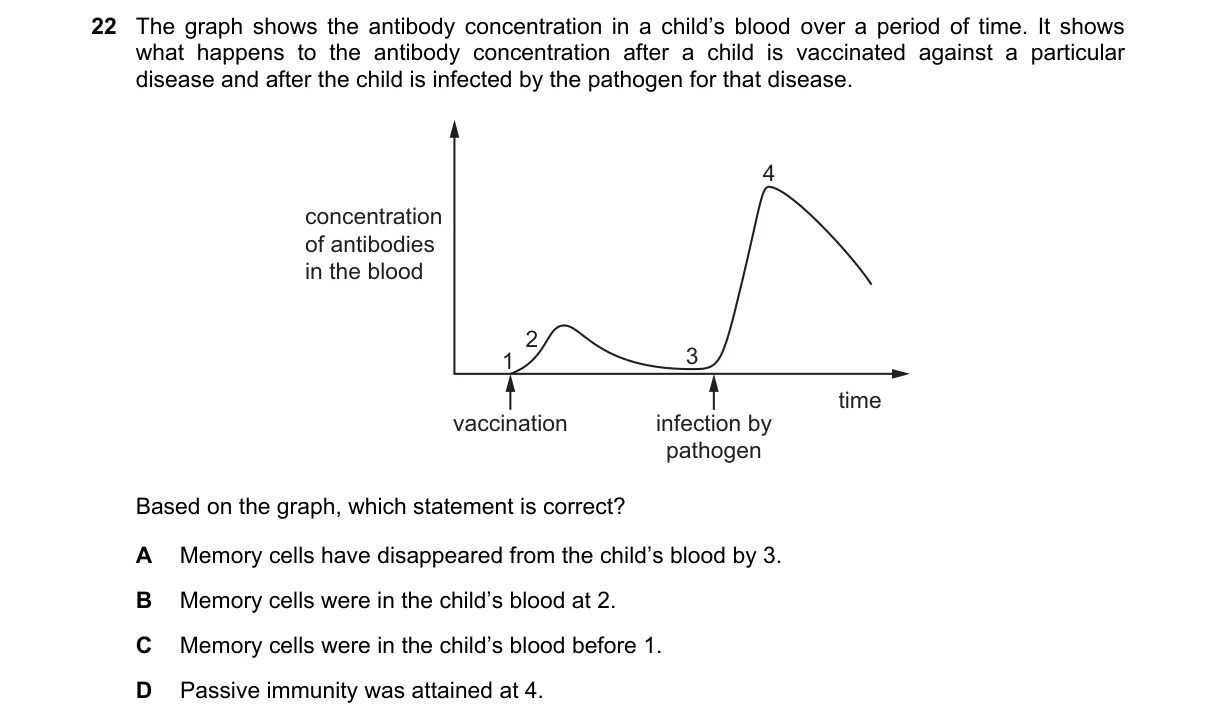
- Vaccination causes primary antibody response: slow rise, peak, then decline, producing memory cells.
- Memory cells persist after primary response, enabling rapid secondary response upon infection.
- Graph likely shows low antibodies before infection (point 1), then sharp rise (secondary response).
- Thus, memory cells exist before point 1 (post-vaccination, pre-infection).
Why B is correct:
- Memory cells form during primary response to vaccination and remain in blood long-term, priming faster antibody production upon pathogen exposure (immunological memory principle).
Why the others are wrong:
- A: Memory cells are long-lived and persist beyond point 3 to drive ongoing immunity.
- C: Passive immunity requires external antibody transfer (e.g., maternal), not the active secondary response at 4.
- D: Memory cells appear after primary response (pre-point 2 if 2 marks early secondary), but were already present before 1.
Final answer: B
Topic: Immunity
Practice more O Levels Biology (5090) questions on mMCQ.me