O Levels Biology (5090)•5090/12/O/N/22
Explanation
Partial permeability in plant cell structures during osmosis
Steps:
- Partially permeable structures allow selective passage of molecules, like water but not solutes, enabling osmosis.
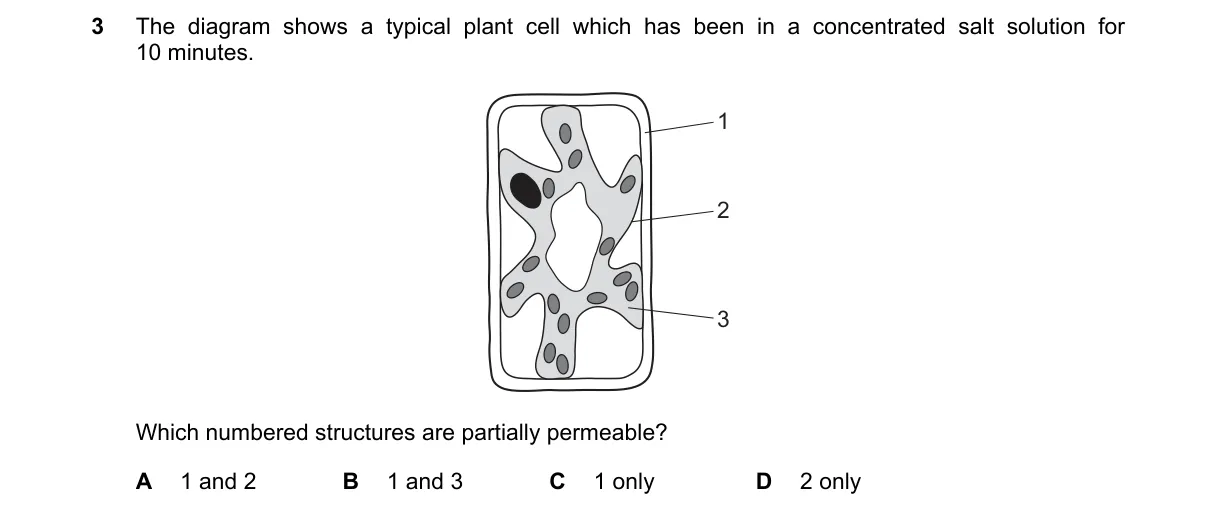
- In a typical plant cell diagram, structure 1 is the cell wall (freely permeable to water and salts), structure 2 is the plasma membrane (selectively permeable), and structure 3 is the vacuole membrane (tonoplast, also partially permeable but not the focus here).
- After 10 minutes in concentrated salt solution, plasmolysis occurs: cytoplasm pulls away from cell wall, indicating the plasma membrane controls water loss via osmosis.
- Only the plasma membrane (structure 2) acts as the barrier regulating solute entry, confirming its partial permeability.
Why D is correct:
- The plasma membrane is defined as partially permeable, allowing water diffusion while blocking salt ions, per osmosis principles.
Why the others are wrong:
- A: Structure 1 (cell wall) is fully permeable, not selective.
- B: Includes structure 1 (fully permeable) and 3 (not the primary barrier shown).
- C: Structure 1 (cell wall) permits all small molecules freely.
Final answer: D
Topic: Diffusion and osmosis
Practice more O Levels Biology (5090) questions on mMCQ.me