O Levels Biology (5090)•5090/11/O/N/21
Explanation
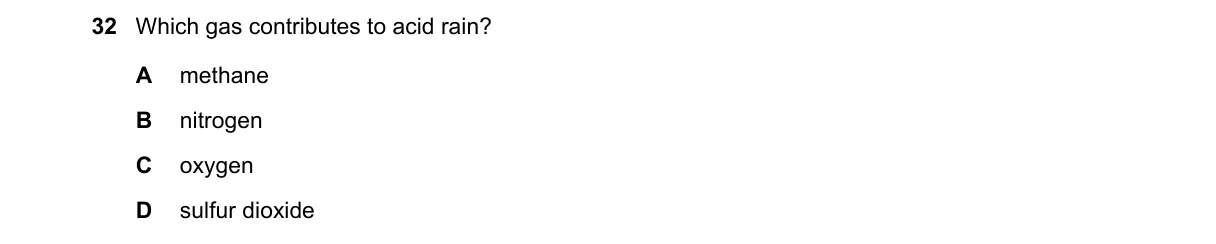
Acid rain from sulfur dioxide emissions
Steps:
- Identify acid rain as precipitation with pH below 5.6, caused by atmospheric pollutants.
- Recall main pollutants: sulfur dioxide (SO2) and nitrogen oxides (NOx) from burning fossil fuels.
- Determine which option matches: sulfur dioxide is a primary contributor.
- Eliminate non-acidic gases that don't form acids in the atmosphere.
Why D is correct:
- Sulfur dioxide reacts with water vapor to form sulfuric acid (H2SO4), lowering rain pH per the reaction: SO2 + H2O → H2SO3 (sulfurous acid), which oxidizes to H2SO4.
Why the others are wrong:
- A. Methane is a greenhouse gas but does not form acids in rainwater.
- B. Nitrogen gas (N2) is inert and unreactive in the atmosphere.
- C. Oxygen is essential for life but does not contribute to acidification.
Final answer: D
Topic: Effects of humans on ecosystems
Practice more O Levels Biology (5090) questions on mMCQ.me