O Levels Biology (5090)•5090/11/O/N/19
Explanation
Intestinal Sugar Absorption Mechanisms
Steps:
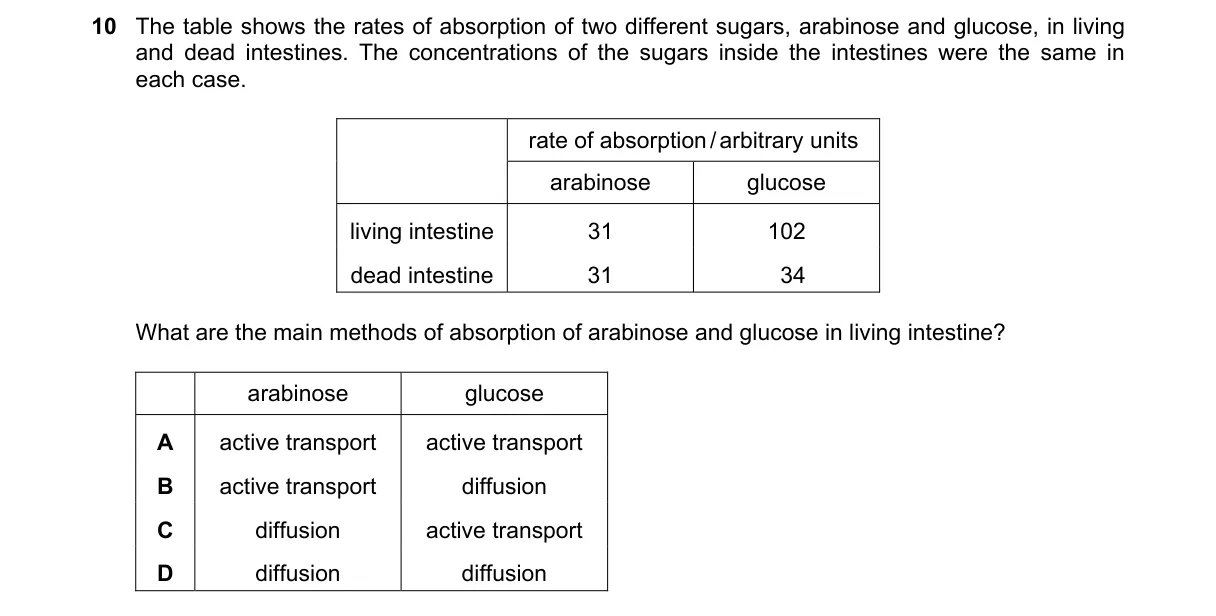
- Recall that glucose absorption in the small intestine uses secondary active transport via SGLT1 cotransporter with sodium ions to move against its concentration gradient.
- Note that arabinose, a pentose sugar, lacks a specific active transporter and relies on passive diffusion down its concentration gradient.
- Compare options: Active transport requires energy and specificity; diffusion is passive and non-specific.
- Match: Arabinose fits diffusion, glucose fits active transport, selecting B.
Why B is correct:
- Glucose absorption follows the secondary active transport law, using Na+ electrochemical gradient (via Na+/K+ ATPase) to enable uphill movement, as defined in epithelial transport physiology.
Why the others are wrong:
- A: Arabinose uses diffusion, not active transport, due to no dedicated cotransporter.
- C: Glucose requires active transport, not diffusion, to overcome low luminal concentrations.
- D: Glucose does not use simple diffusion; it needs active uptake for efficient absorption.
Final answer: B
Topic: Absorption and assimilation
Practice more O Levels Biology (5090) questions on mMCQ.me