O Levels Biology (5090)•5090/12/O/N/18
Explanation
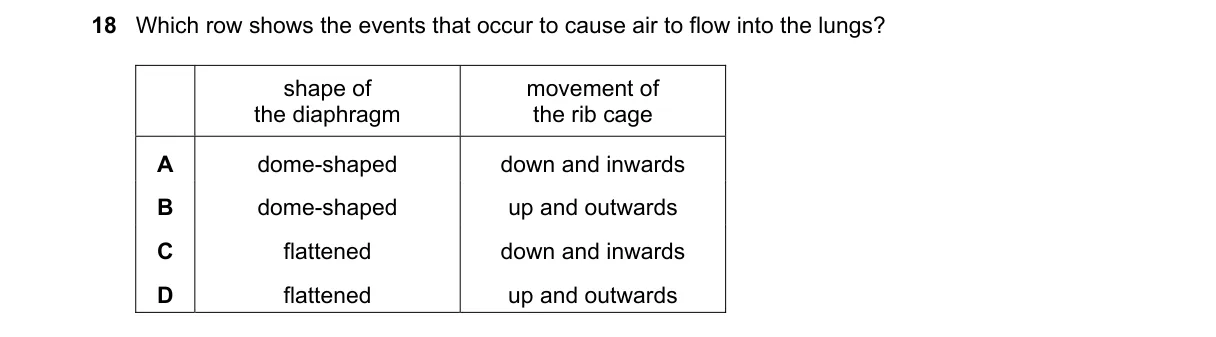
Diaphragm and rib cage movements in inhalation
Steps:
- Air flows into lungs during inhalation when thoracic volume increases, lowering internal pressure below atmospheric pressure.
- Diaphragm contracts, changing from dome-shaped to flattened while descending to enlarge vertical dimension.
- External intercostal muscles contract, elevating ribs up and outwards to expand lateral and anterior-posterior dimensions.
- Combined actions create pressure gradient drawing air in.
Why D is correct:
- Flattened up and outwards matches diaphragm flattening with rib cage elevation, per Boyle's law where volume increase reduces pressure for inflow.
Why the others are wrong:
- A: Dome-shaped down and inwards describes exhalation, where diaphragm relaxes and rises, decreasing volume.
- B: Dome-shaped up and outwards is incorrect; diaphragm is dome-shaped at rest, not during active inhalation movement.
- C: Flattened down and inwards wrongly implies inward collapse, reducing volume instead of expanding it.
Final answer: D
Topic: Human gas exchange
Practice more O Levels Biology (5090) questions on mMCQ.me