Explanation
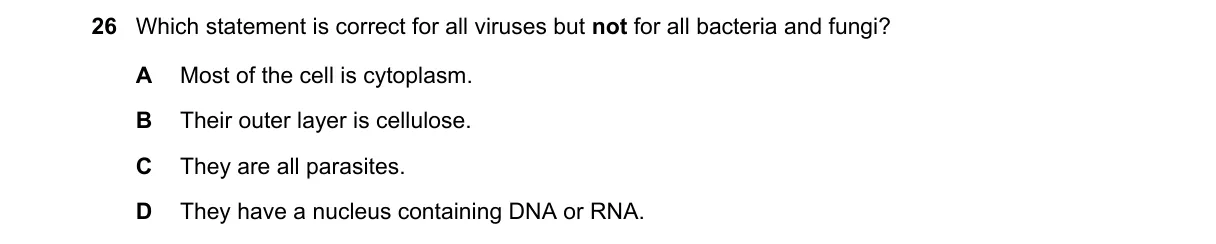
Viruses as obligate parasites Steps: - Recall that viruses lack cellular structure and cannot reproduce independently, unlike bacteria and fungi which are cellular and can grow autonomously. - Evaluate each option: A applies to cellular organisms like bacteria and fungi; B describes plant cell walls, not microbes; C fits viruses' dependence on hosts; D is inaccurate for viruses' non-nucleated genetic material. - Confirm C: Viruses require host cells for replication, making them parasitic, while many bacteria and fungi are free-living. - Eliminate others based on biological definitions of these organisms. Why C is correct: - Viruses are obligate intracellular parasites by definition, as they hijack host machinery for replication, unlike bacteria and fungi which can often live independently. Why the others are wrong: - A: Viruses are acellular with no cytoplasm, while bacteria and fungi are mostly cytoplasmic cells. - B: No organism here has a cellulose outer layer; bacteria have peptidoglycan walls, fungi chitin, viruses protein coats. - D: Viruses lack a true nucleus and have naked DNA or RNA, unlike nucleated bacteria (prokaryotes) and fungi (eukaryotes). Final answer: …
Practice more O Levels Biology (5090) questions on mMCQ.me