O Levels Biology (5090)•5090/11/M/J/25
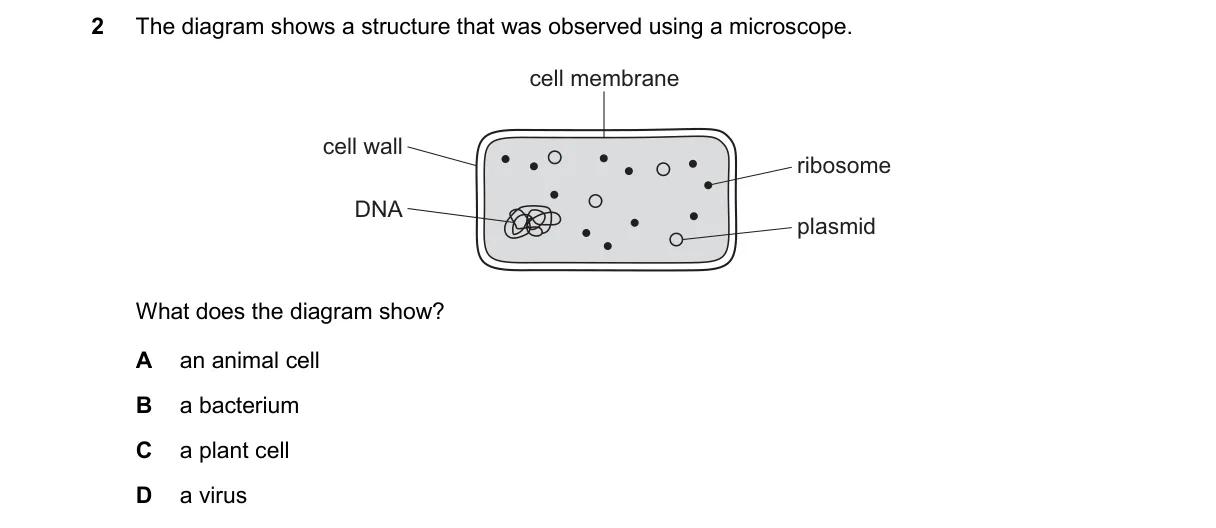
Explanation
Identifying prokaryotic vs. eukaryotic cells
Steps:
- Examine the diagram for presence of a nucleus: absence indicates prokaryote.
- Check for membrane-bound organelles: lack suggests bacterium over eukaryotic cells.
- Note size and shape: small, rod or coccus form typical of bacteria.
- Rule out non-cellular entities: visible cell wall and cytoplasm point to bacterial cell.
Why B is correct:
- Bacteria are prokaryotes lacking a true nucleus and membrane-bound organelles, matching the diagram's simple structure per cell theory definitions.
Why the others are wrong:
- A: Animal cells are eukaryotic with a defined nucleus and no cell wall.
- C: Plant cells have chloroplasts, a large vacuole, and cellulose cell wall.
- D: Viruses are acellular, consisting only of nucleic acid in a protein coat, not a complete cell.
Final answer: B
Topic: Cell structure and function
Practice more O Levels Biology (5090) questions on mMCQ.me