O Levels Biology (5090)•5090/12/M/J/24
Explanation
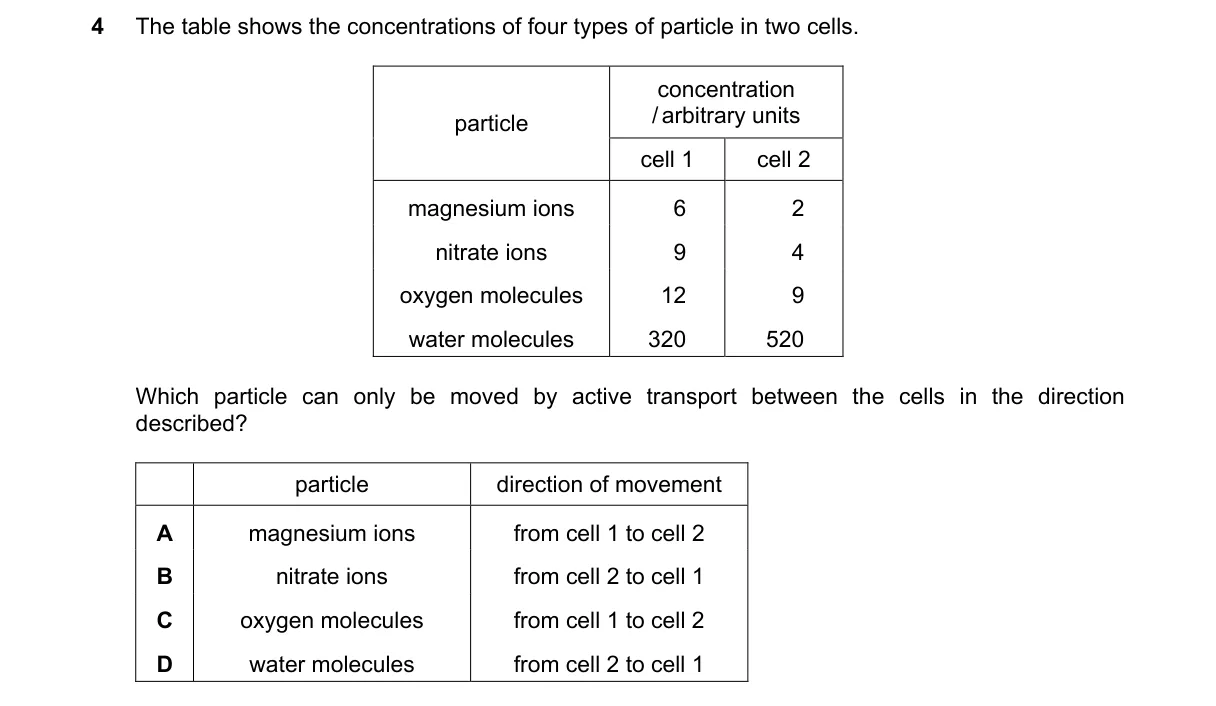
Active transport requires movement against concentration gradients
Steps:
- Compare particle concentrations between cells to identify gradients.
- Active transport moves particles from low to high concentration; passive transport moves from high to low.
- Check each option's direction against the table's gradients.
- Select the option where movement opposes the gradient.
Why B is correct:
- Oxygen concentration is higher in cell 1 than cell 2, so moving oxygen from cell 2 (low) to cell 1 (high) is against the gradient, requiring energy per active transport definition.
Why the others are wrong:
- A: Nitrate ions are lower in cell 1 than cell 2, so movement from cell 2 to cell 1 follows the gradient via passive transport.
- C: Water moves from cell 1 (higher water potential) to cell 2 via osmosis, a passive process.
- D: Water moves from cell 2 (higher water potential) to cell 1 via osmosis, a passive process.
Final answer: B
Topic: Active transport
Practice more O Levels Biology (5090) questions on mMCQ.me