O Levels Biology (5090)•5090/11/M/J/23
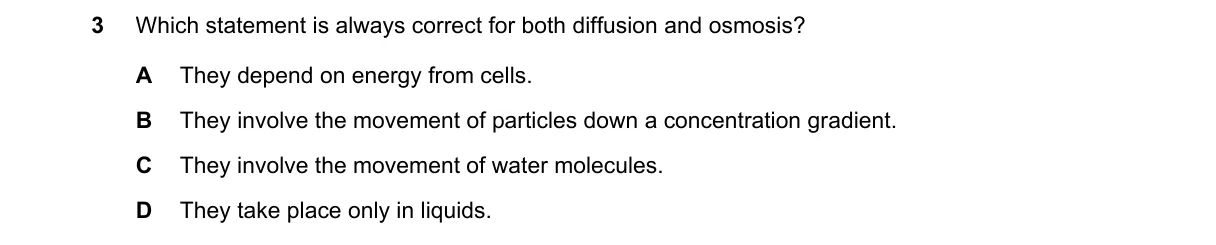
Explanation
Shared passive movement in diffusion and osmosis
Steps:
- Define diffusion as net movement of any particles from high to low concentration.
- Define osmosis as net movement of water across a semi-permeable membrane from high to low water concentration.
- Identify common feature: both processes move substances down their concentration gradients without energy input.
- Eliminate options not shared by both: diffusion applies to various particles and states, not just water or liquids, and requires no cellular energy.
Why A is correct:
- Both follow Fick's law of diffusion, where net flux occurs down the concentration gradient until equilibrium.
Why the others are wrong:
- B: Diffusion involves any particles (e.g., gases like oxygen), not always water.
- C: Diffusion occurs in gases, liquids, and solids; osmosis requires a membrane but not exclusively liquids.
- D: Both are passive processes, relying on kinetic energy, not cellular ATP.
Final answer: A
Topic: Diffusion and osmosis
Practice more O Levels Biology (5090) questions on mMCQ.me