O Levels Biology (5090)•5090/11/M/J/23
Explanation
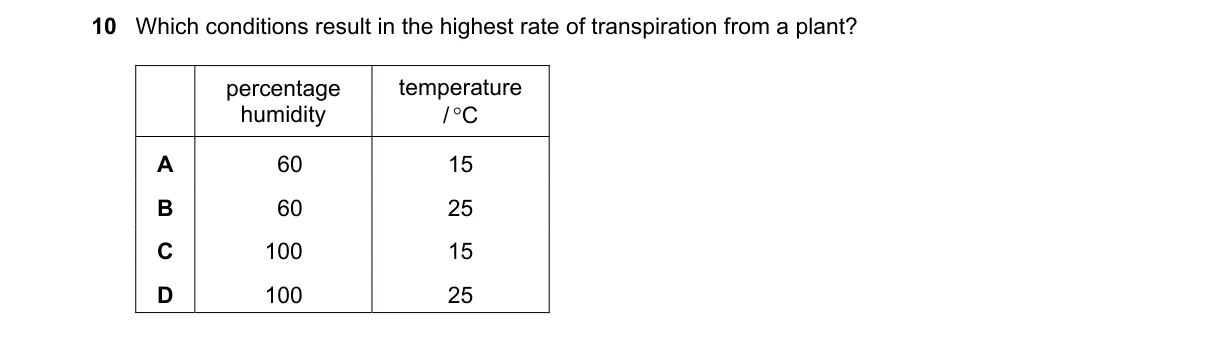
Transpiration highest with low humidity and high temperature
Steps:
- Transpiration rate increases as humidity decreases due to steeper water vapor gradient from leaf to air.
- Transpiration rate increases with temperature as it boosts evaporation and diffusion kinetics.
- Evaluate humidity: 60% (A, B) allows higher rate than 100% (C, D).
- Evaluate temperature: 25°C (B, C) allows higher rate than 15°C (A, D); B combines lowest humidity and highest temperature.
Why B is correct:
- B features 60% humidity (steep gradient per Fick's law of diffusion) and 25°C (elevated evaporation rate), maximizing transpiration.
Why the others are wrong:
- A: Lower temperature (15°C) reduces evaporation compared to B.
- C: High humidity (100%) minimizes vapor gradient, halting transpiration.
- D: High humidity (100%) and low temperature (15°C) both suppress transpiration.
Final answer: B
Topic: Transpiration and translocation
Practice more O Levels Biology (5090) questions on mMCQ.me