O Levels Biology (5090)•5090/11/M/J/22
Explanation
Ray convergence in the eye for distant vision
Steps:
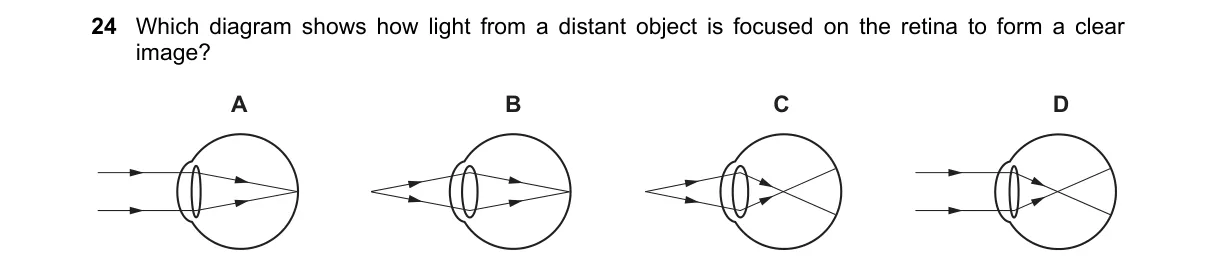
- Light rays from a distant object enter the eye as parallel beams due to infinite distance.
- The convex lens of the eye refracts these parallel rays to converge at a single point.
- In normal vision, this focal point lies exactly on the retina.
- The correct diagram illustrates parallel incoming rays focusing sharply on the retina without distortion.
Why A is correct:
- Diagram A depicts parallel rays from infinity converging precisely on the retina, aligning with the lens formula where is infinite, so , the focal length.
Why the others are wrong:
- B shows diverging rays, incorrect for distant objects which produce parallel light.
- C illustrates focus in front of the retina, typical of hyperopia, not clear vision.
- D depicts blurred convergence behind the retina, as in myopia for distant objects.
Final answer: A
Topic: Mammalian sense organs
Practice more O Levels Biology (5090) questions on mMCQ.me