O Levels Biology (5090)•5090/12/M/J/21
Explanation
Aerobic Respiration Breaks Down Glucose Using Oxygen
Steps:
- Recall the definition: Aerobic respiration is the process where cells use oxygen to fully oxidize glucose, releasing energy.
- Identify the overall reaction: C6H12O6 + 6O2 → 6CO2 + 6H2O + ATP (energy).
- Evaluate each option against this reaction and process location.
- Select the statement that accurately describes the breakdown or role of components.
Why C is correct:
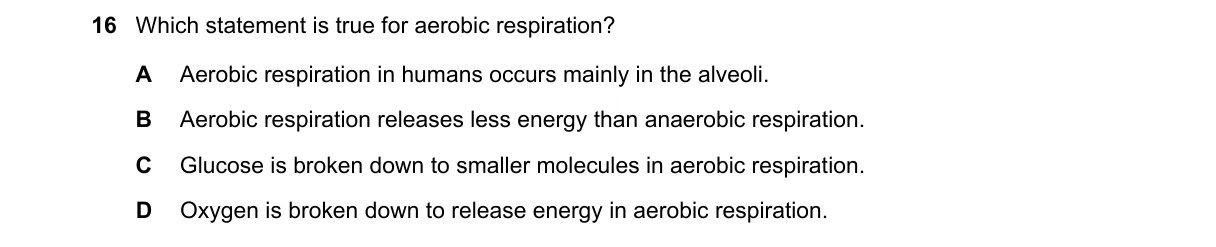
- In aerobic respiration, glucose (C6H12O6) is oxidized to smaller molecules like CO2 and H2O, as shown in the balanced equation, producing maximum ATP.
Why the others are wrong:
- A: Aerobic respiration occurs in mitochondria, not alveoli, which handle gas exchange in lungs.
- B: Aerobic respiration releases more energy (up to 38 ATP) than anaerobic (only 2 ATP).
- D: Oxygen acts as the final electron acceptor to form water, not broken down for energy release.
Final answer: C
Topic: Aerobic respiration
Practice more O Levels Biology (5090) questions on mMCQ.me