O Levels Biology (5090)•5090/11/M/J/21
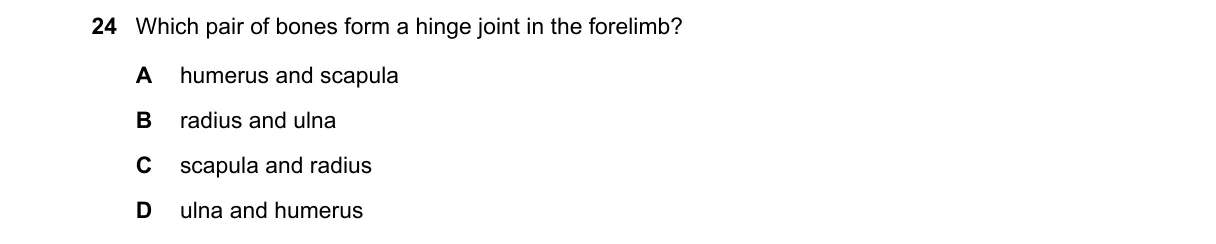
Explanation
Elbow hinge joint anatomy
Steps:
- Identify hinge joints as synovial joints allowing uniaxial movement like flexion-extension.
- Locate the forearm as containing radius and ulna bones, connecting to the humerus at the elbow.
- Recall the elbow's primary hinge component is the humeroulnar articulation.
- Confirm via anatomy: humerus trochlea fits ulna's trochlear notch for hinge action.
Why D is correct:
- The humeroulnar joint is defined as a hinge joint, where the humerus's trochlea articulates with the ulna's olecranon and trochlear notch for pure flexion-extension.
Why the others are wrong:
- A: Humerus and scapula form the glenohumeral ball-and-socket joint at the shoulder, allowing multiaxial rotation.
- B: Radius and ulna form pivot joints (proximal/distal radioulnar) for forearm pronation-supination, not hinging.
- C: Scapula articulates with humerus, not radius; no direct forearm hinge exists here.
Final answer: D
Topic: Specialised cells, tissues and organs
Practice more O Levels Biology (5090) questions on mMCQ.me