O Levels Biology (5090)•5090/11/M/J/19
Explanation
Water Potential Gradient in Plant Roots
Steps:
- Water enters root cells from soil via osmosis, moving from higher to lower water potential.
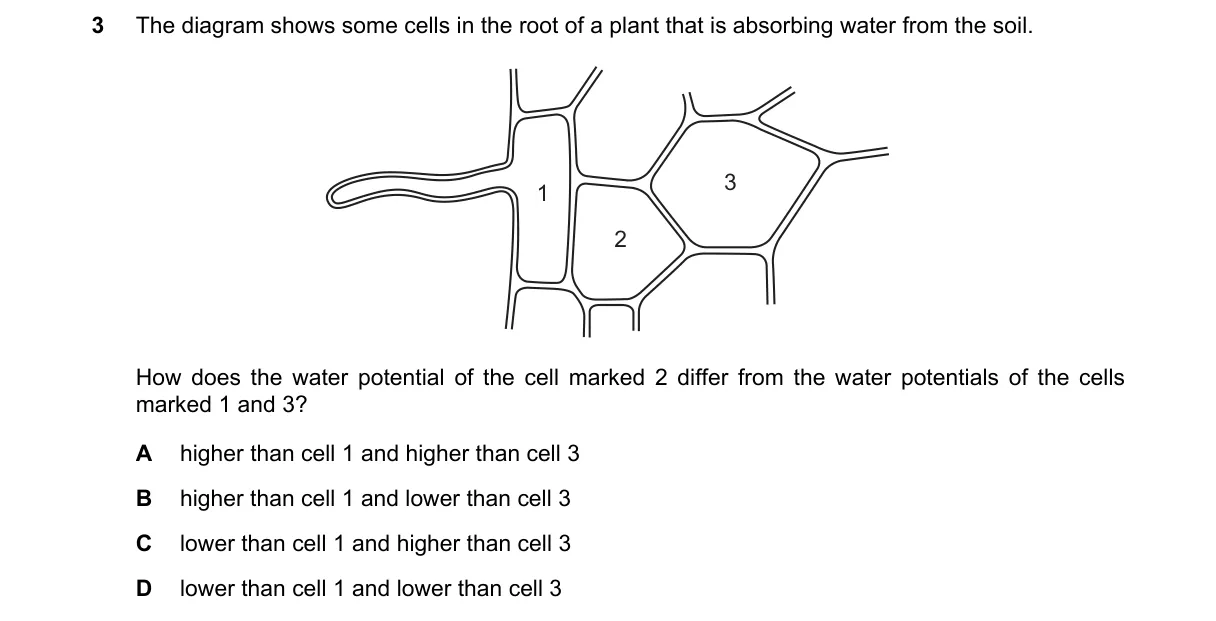
- In roots, water potential decreases progressively from outer cells (epidermis) toward inner cells (xylem) to drive absorption.
- Cell 1, being outermost, has the highest water potential among the marked cells.
- Cell 3, being innermost, has the lowest water potential, creating the gradient.
Why C is correct:
- Water potential (ψ) follows a decreasing gradient inward; ψ2 is intermediate, so lower than ψ1 (outer) but higher than ψ3 (inner), per the osmosis principle where water flows toward lower ψ.
Why the others are wrong:
- A: ψ2 cannot be higher than both, as that would reverse the inward flow.
- B: ψ2 cannot be higher than ψ1, blocking water entry from soil.
- D: ψ2 cannot be lower than ψ3, halting water movement to the xylem.
Final answer: C
Topic: Diffusion and osmosis
Practice more O Levels Biology (5090) questions on mMCQ.me