O Levels Biology (5090)•5090/12/M/J/18
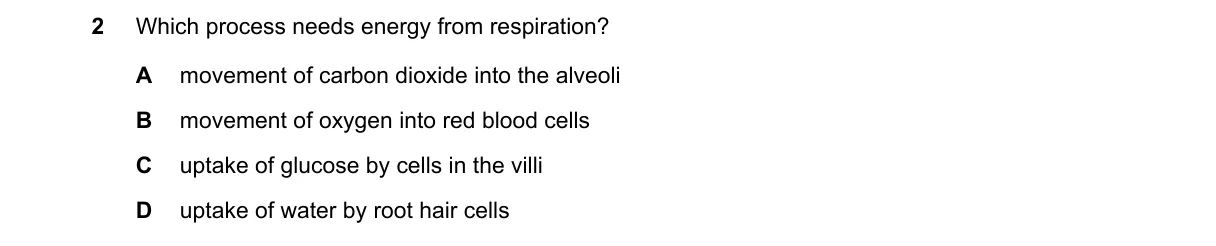
Explanation
Active transport requires cellular energy
Steps:
- Identify processes involving molecule movement across membranes.
- Distinguish between passive (no energy) and active (energy needed) transport.
- Recall respiration provides ATP for active transport.
- Match options to transport types: diffusion is passive, uptake against gradient is active.
Why C is correct:
- Uptake of glucose by cells often uses active transport (e.g., via GLUT transporters with sodium-glucose symporters), requiring ATP from respiration per the definition of active transport as movement against concentration gradients.
Why the others are wrong:
- A: Carbon dioxide diffusion into alveoli is passive, following its concentration gradient without energy.
- B: Oxygen binding to hemoglobin in red blood cells is passive dissolution, not requiring respiration energy.
- D: Water uptake by root cells via osmosis is passive, driven by water potential differences.
Final answer: C
Topic: Active transport
Practice more O Levels Biology (5090) questions on mMCQ.me