O Levels Chemistry (5070)•5070/12/O/N/24
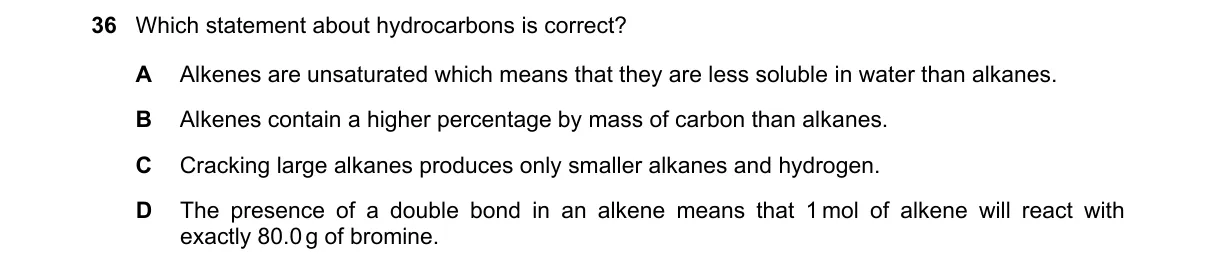
Explanation
Comparing carbon content in hydrocarbons
Steps:
- Recall formulas: alkanes are CnH2n+2, alkenes are CnH2n.
- For same n, alkenes have fewer H atoms, so higher carbon mass percentage.
- Evaluate A: unsaturation doesn't reduce solubility; both types are nonpolar and insoluble in water.
- Evaluate C and D: cracking yields mixed products; bromine adds as 1 mol Br2 (160 g) per mol alkene.
Why B is correct:
- Alkenes (CnH2n) have two fewer H atoms than alkanes (CnH2n+2) for equal carbons, increasing %C by mass (e.g., ethene 85.7% vs. ethane 80%).
Why the others are wrong:
- A: Solubility in water is low for both due to nonpolarity; unsaturation has minimal impact.
- C: Cracking large alkanes yields a mixture of smaller alkanes, alkenes, and hydrogen, not only smaller carbon-hydrogen compounds.
- D: One mole of alkene adds one mole of Br2 (160 g), not 80 g.
Final answer: B
Topic: Alkenes
Practice more O Levels Chemistry (5070) questions on mMCQ.me