O Levels Chemistry (5070)•5070/12/O/N/24
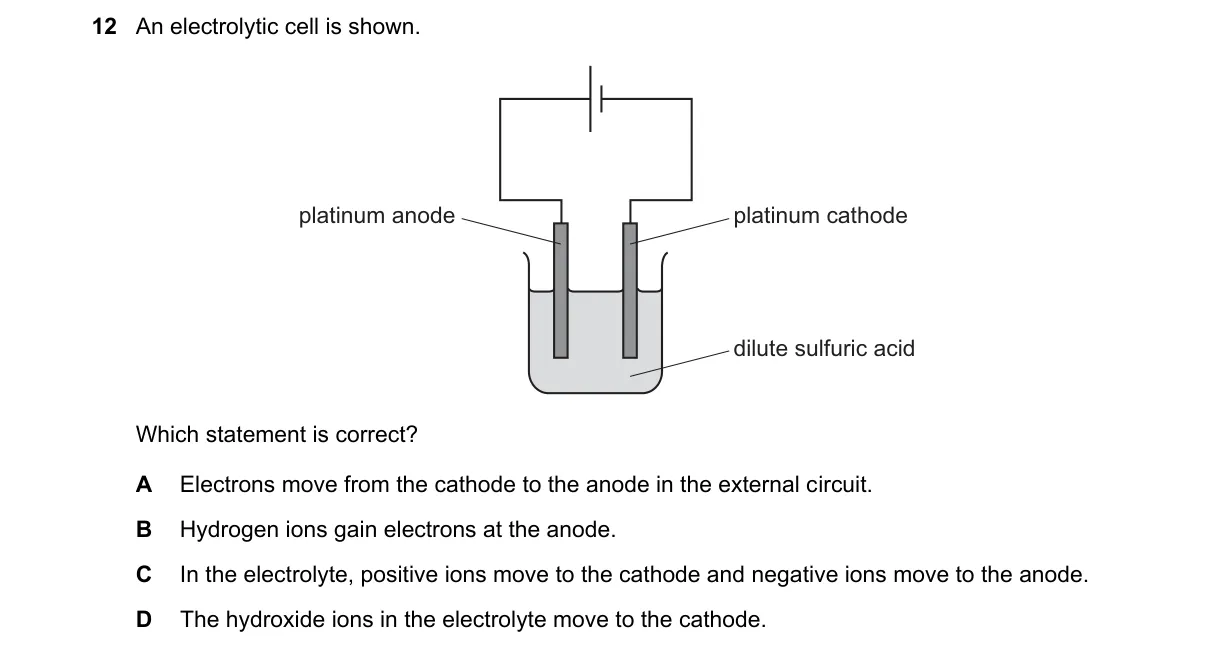
Explanation
Ion Movement in Electrolysis
Steps:
- Identify cathode as negative electrode attracting positive ions (cations) for reduction.
- Identify anode as positive electrode attracting negative ions (anions) for oxidation.
- Confirm cations migrate toward cathode, anions toward anode in the electrolyte.
- Evaluate statements against this standard ion migration rule.
Why B is correct:
- Positive ions (cations) move to the cathode due to attraction by its negative charge, and negative ions (anions) move to the anode by its positive charge, per electrochemical cell principles.
Why the others are wrong:
- A: Electrons flow from anode to cathode in the external circuit of an electrolytic cell, driven by the power source.
- C: Hydroxide ions (OH⁻) are anions, so they move to the anode, not the cathode.
- D: Hydrogen ions (H⁺) are cations and move to the cathode if present, but this is specific to acidic electrolytes, not general.
Final answer: B
Topic: Electrolysis
Practice more O Levels Chemistry (5070) questions on mMCQ.me