O Levels Chemistry (5070)•5070/12/O/N/23
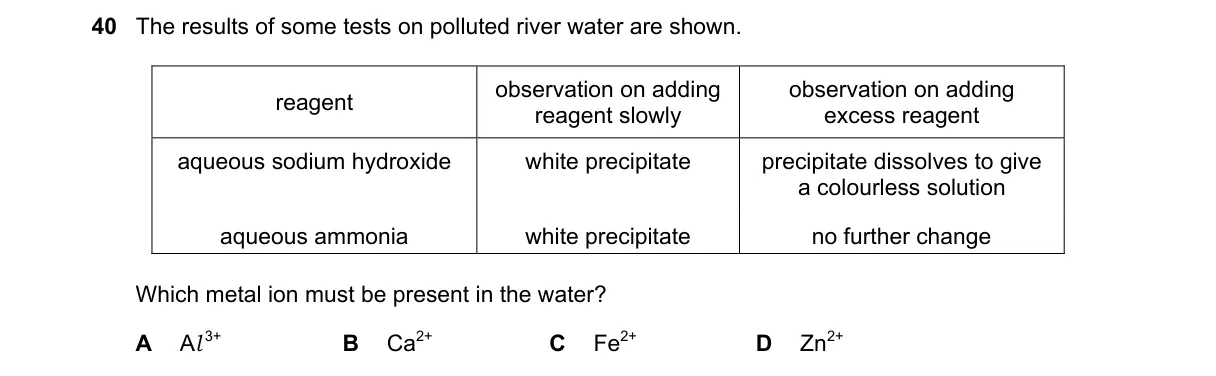
Explanation
Metal ion identification via selective precipitation and solubility tests
Steps:
- NaOH test shows white precipitate dissolving in excess to colorless solution, indicating amphoteric metal hydroxide forming a soluble complex like [M(OH)₄]⁻.
- NH₃ test produces white precipitate unchanged by excess, ruling out metals forming soluble ammine complexes.
- Al³⁺ matches: forms Al(OH)₃ (white ppt) soluble in excess NaOH as [Al(OH)₄]⁻, but insoluble in excess NH₃.
- Other ions fail one or both tests based on their hydroxide/ammonia behaviors.
Why A is correct:
- Al³⁺ hydroxide is amphoteric, dissolving in excess NaOH per the reaction Al(OH)₃ + OH⁻ → [Al(OH)₄]⁻, but remains insoluble in NH₃.
Why the others are wrong:
- B. Ca²⁺: Forms white Ca(OH)₂ ppt insoluble in excess NaOH or NH₃.
- C. Fe²⁺: Forms green gelatinous ppt with NaOH, insoluble in excess; dirty green ppt with NH₃, insoluble.
- D. Zn²⁺: White ppt with NaOH dissolves in excess; white ppt with NH₃ dissolves to form [Zn(NH₃)₄]²⁺.
Final answer: A
Topic: Identification of ions and gases
Practice more O Levels Chemistry (5070) questions on mMCQ.me